Ceres: who scattered salt in the asteroid belt?
The largest body in the asteroid belt is also its only dwarf planet. Dawn revealed remnant salty water beneath its icy crust and bright salt deposits in Occator Crater.
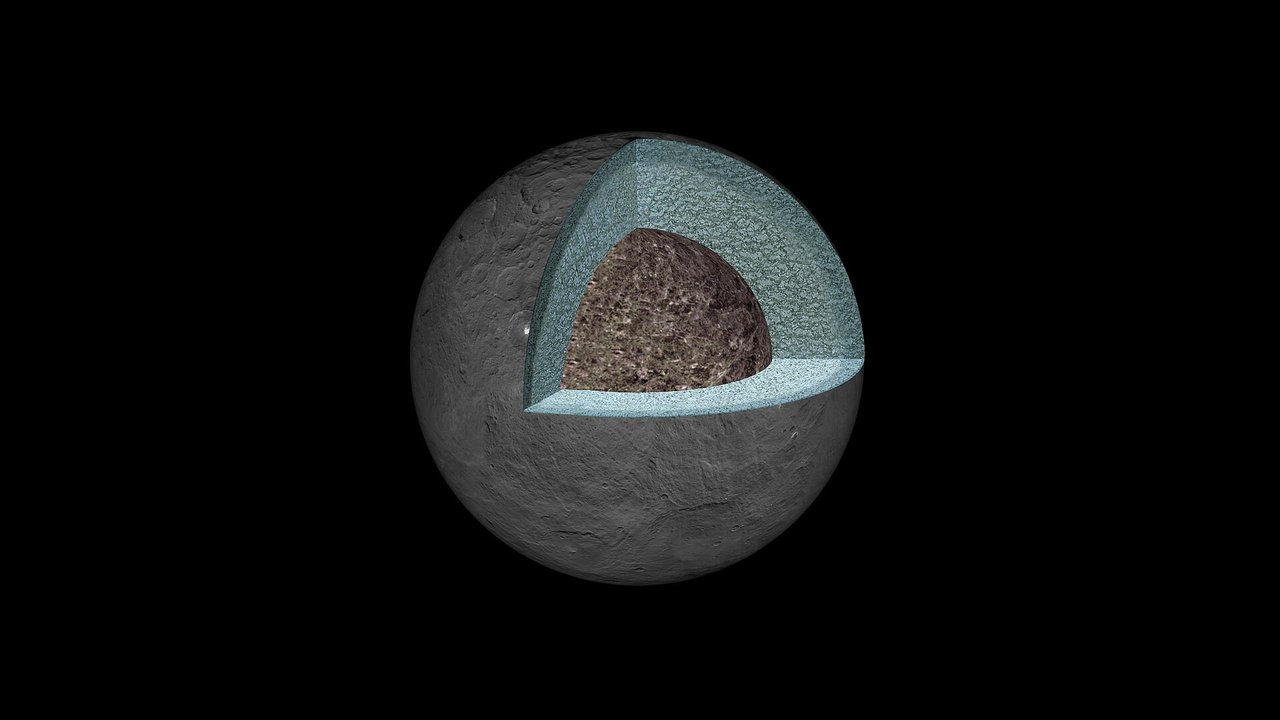
Ceres is a miniature world about 940 km across, the largest body in the asteroid belt and its only recognized dwarf planet. It holds roughly a third of the belt’s total mass.
The missing planet
Giuseppe Piazzi discovered Ceres on January 1, 1801, during the era of searching for a missing planet between Mars and Jupiter. Further discoveries revealed an entire asteroid belt instead. Ceres orbits at about 2.8 AU in 4.6 Earth years and rotates in about nine hours. It was classified as a dwarf planet in 2006, the closest one to the Sun.
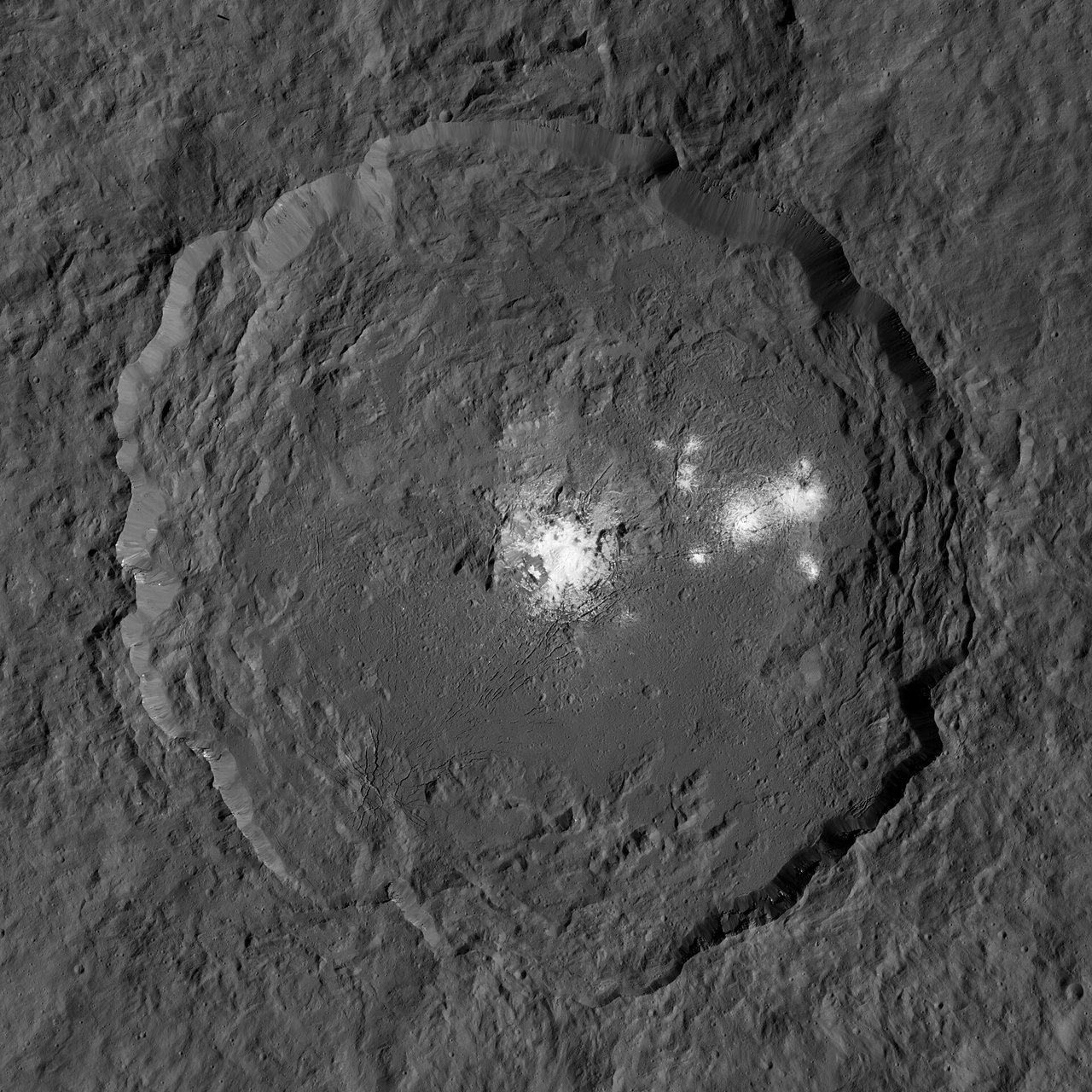
Occator’s bright spots
As Dawn approached in early 2015, white spots inside the roughly 92 km Occator Crater stood out. Spectra revealed abundant sodium carbonate. Central Cerealia Facula and the eastern Vinalia Faculae are salts deposited when brines from inside Ceres reached the surface and lost their water.
Remnant brines beneath the crust
Ceres’s density, about 2.1 g/cm³, indicates substantial ice. Gravity measurements suggest a rocky interior, ice- and salt-rich layers, and a mixed outer crust. A young global ocean may have mostly frozen, leaving regional brine reservoirs tens of kilometers below Occator. The impact opened pathways for that fluid. Some deposits are geologically young, so activity ended recently or may not have entirely ceased.
Dawn: orbiting two worlds
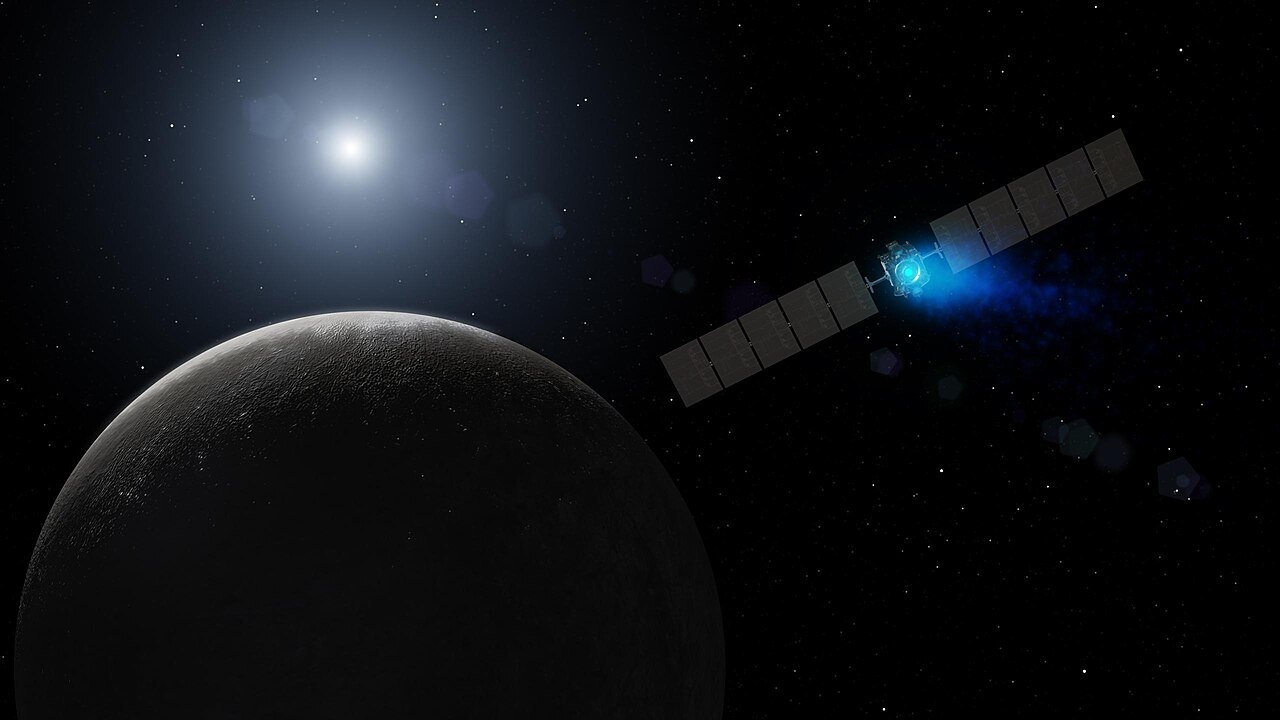
Launched in September 2007, Dawn used efficient ion propulsion to orbit Vesta for fourteen months, then enter Ceres orbit on March 6, 2015—the first spacecraft to orbit two extraterrestrial bodies in succession. It descended as low as about 35 km, resolving bright spots, possible cryovolcano Ahuna Mons, exposed ice, and organic compounds. The mission ended on November 1, 2018 after attitude-control fuel ran out. Dawn remains in orbit.
Why does Ceres matter?
It preserves early interactions between water and rock, a time capsule from the solar system’s formation. Residual brines, salts, and organic material show that water-related processes occur in the asteroid belt as well as on Earth and icy moons.
Do the bright spots glow?
No. They reflect sunlight more efficiently than surrounding dark ground, like white salt on a dark table. Ceres has no breathable atmosphere, and gravity is around one-thirtieth of Earth’s. A visitor would still need a spacesuit and careful movement.