Didymos: a planetary-defense test site
Why did humanity choose this pair for its first asteroid-deflection test? The answer lies in the small companion’s orbit.
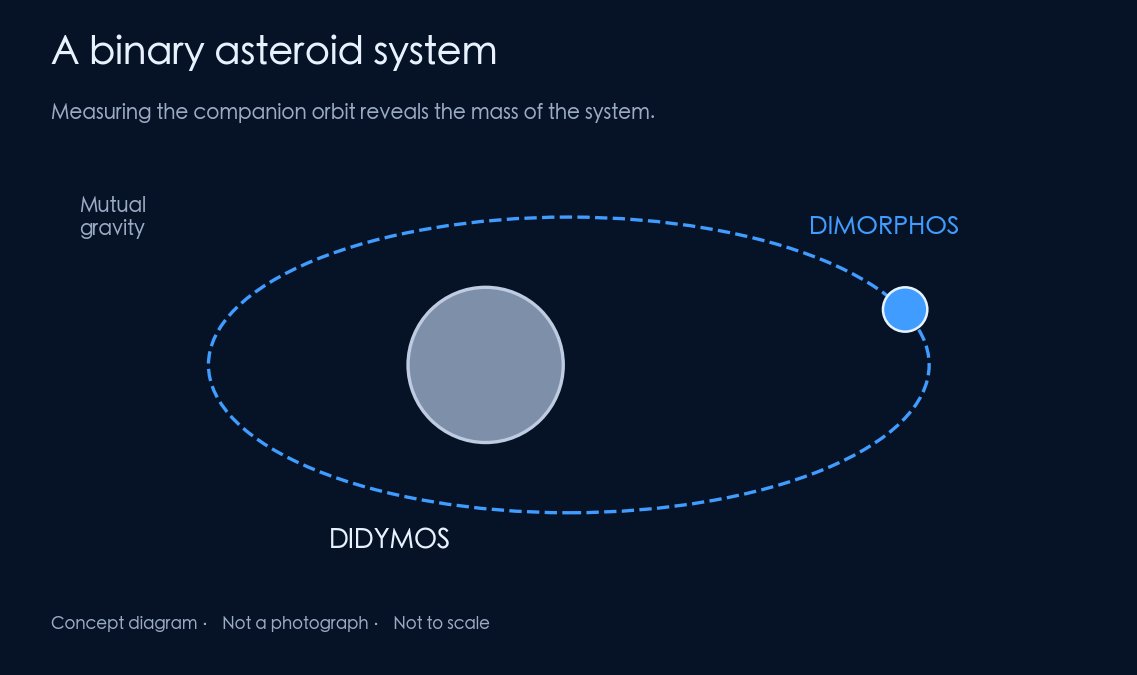
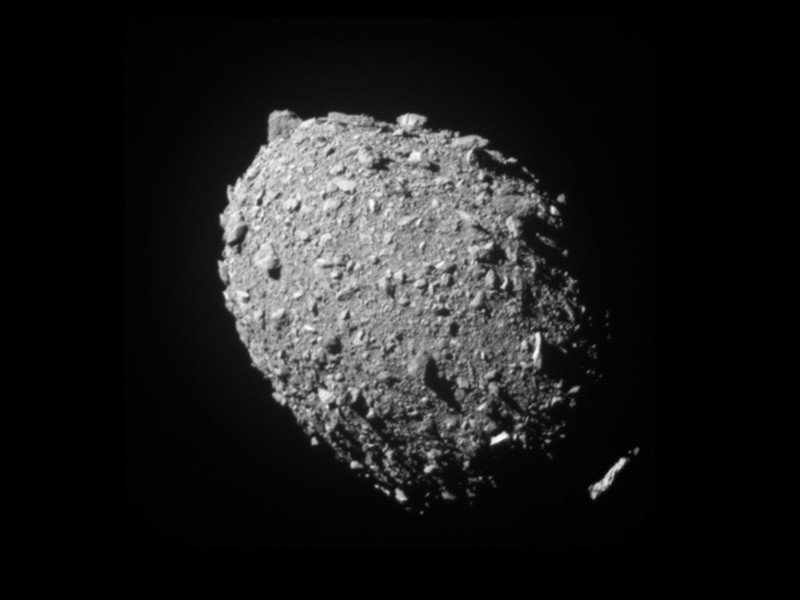
Didymos has a smaller companion, Dimorphos. Both orbit the Sun, while the companion also circles the primary. To test whether a spacecraft impact changes motion, this system supplies its own measurable clock.
The larger asteroid was not struck
DART hit Dimorphos in September 2022. Didymos provided the gravitational setting: comparing the companion’s orbital period before and after revealed the effect. Neither object threatened Earth at the time.
How do we measure the changed period?
Seen from Earth, the bodies periodically obscure one another, dimming their combined light. These recurring dips mark an orbital rhythm. Repeated measurements and other observations reconstruct their motion with remarkable precision.
What can two rocks teach us?
Gravity, spin, and the packing of rubble shape small bodies. The same push can affect a steel ball and a bag of stones differently. Didymos turns planetary defense from a simulation into a testable experiment and helps explain asteroid moons.
Was this an emergency rescue of Earth?
No. It was a technology demonstration undertaken in advance. Kinetic impact changed the target’s motion, but another asteroid would require knowledge of its size, structure, orbit, and warning time. One successful experiment begins the process of building reliable methods.