Dimorphos: after humanity gave it a push
A spacecraft’s final act changed an asteroid’s orbital rhythm. Planetary defense has no movie-style explosion button, but it does have real experiments.
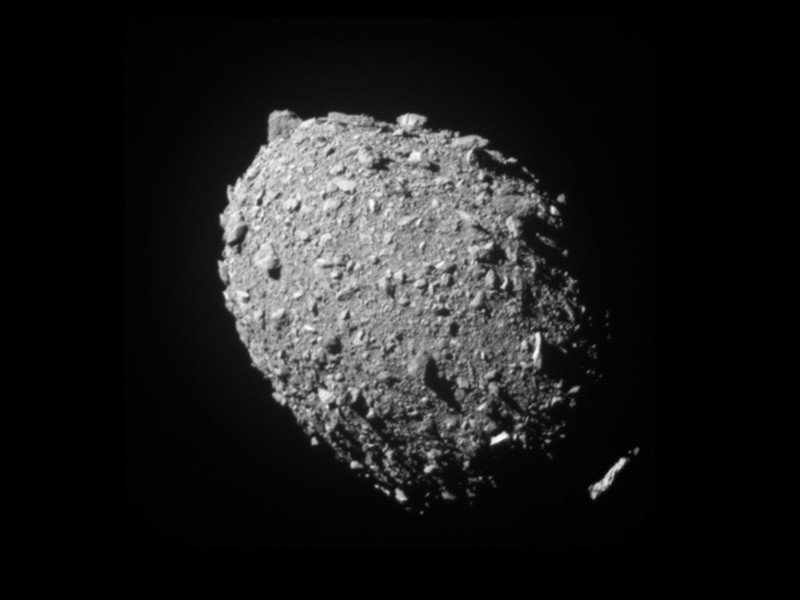
In DART’s final images, Dimorphos grew from a point into a frame filled with rocks. Then transmission stopped—not an accidental outage, but the mission’s planned impact.
No destruction button
DART carried no movie-style bomb. Its speed supplied momentum, and escaping ejecta increased the recoil. Throwing a bag from a skateboard similarly pushes the rider in the opposite direction.
Is half an hour a large change?
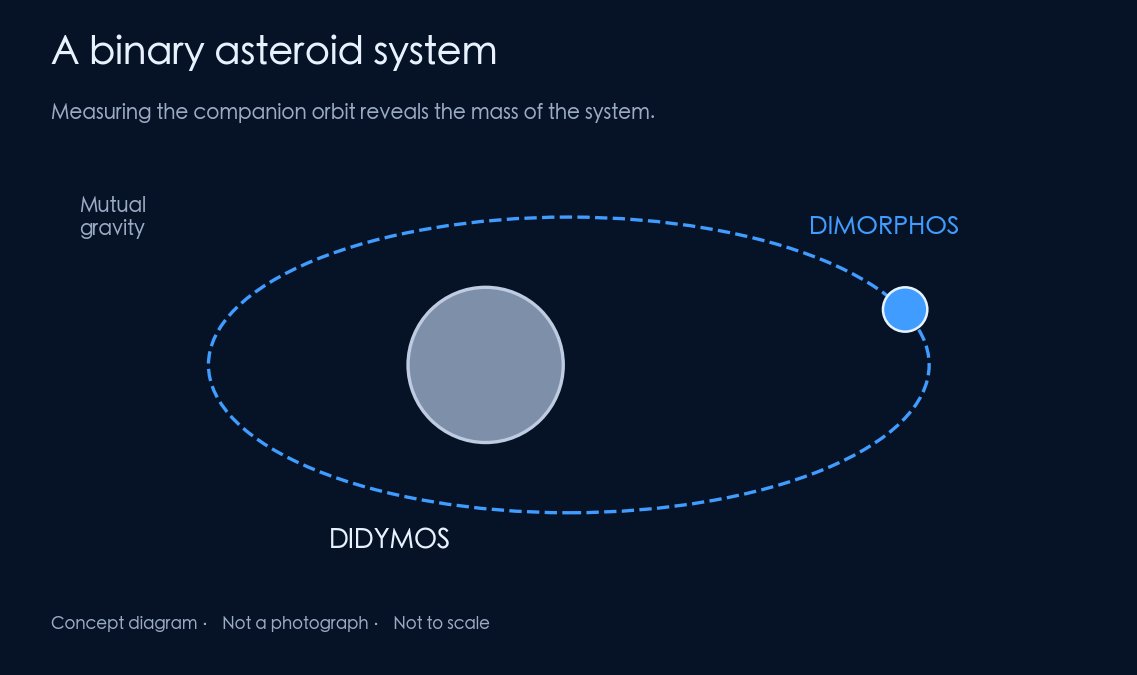
Before impact, Dimorphos orbited in about 11 hours 55 minutes. Later analysis found a reduction around 33 minutes. Early reports often quoted 32 minutes; measurements naturally improve as observations accumulate.
Its shape changed too
Observations and models suggest effects beyond a crater: the overall shape and orbit changed, consistent with a loose aggregate. Follow-up close observations will test these explanations.
Why does early detection matter?
Deflection usually aims for a small, early velocity change that accumulates into a large positional difference over time. It is like taking a different road well before reaching a junction. This experiment validates one tool, not a universal recipe for every asteroid.