Hyperion: a tumbling space sponge
Deep craters, low density, and an unruly spin: this Saturnian moon’s strange appearance is no photographic error.
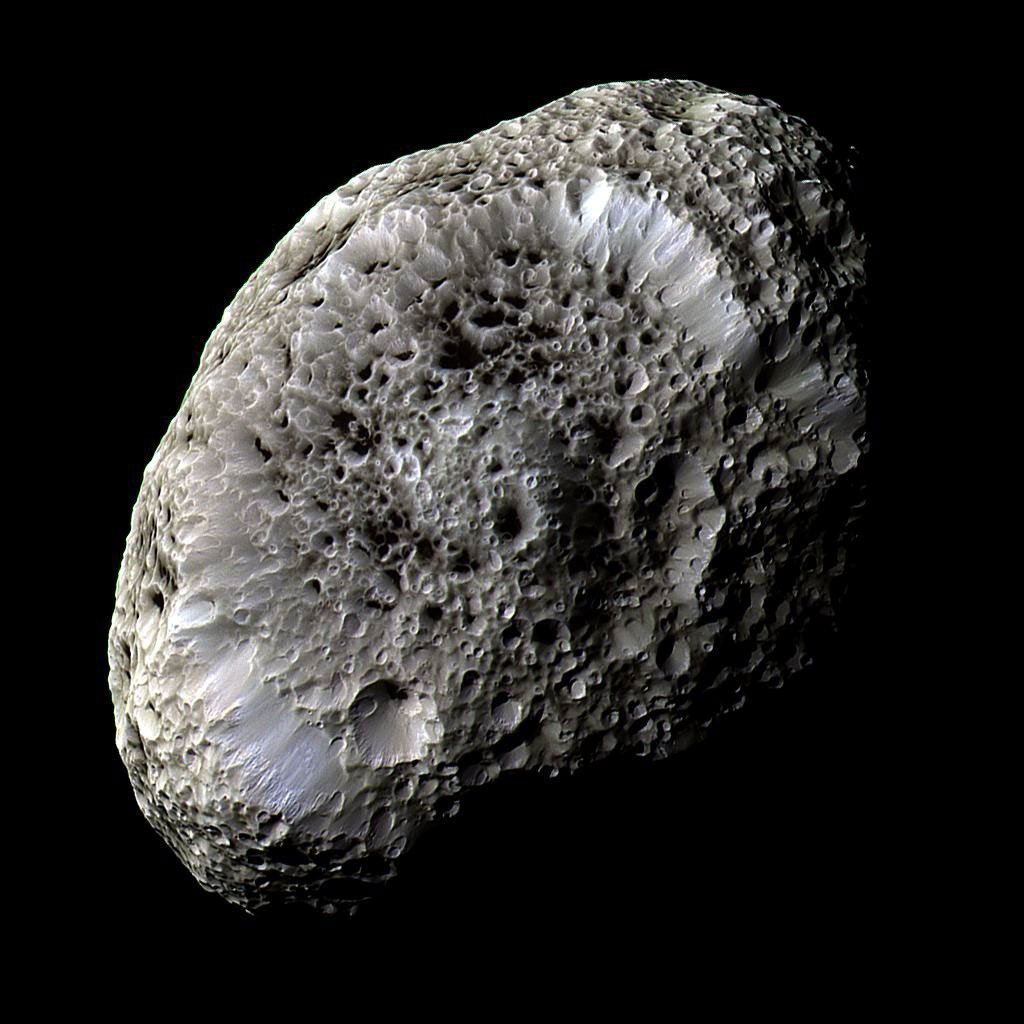
Hyperion resembles a sponge or honeycomb: irregular, low-density, and possibly full of internal voids. Sponge describes appearance and porosity, not a soft material suitable for washing dishes.
Why do the craters look so deep?
Porous material compresses differently from solid rock during impacts. Weak gravity lets ejecta escape, while dark crater floors accentuate depth. Together these effects create the unforgettable surface.
Which side faces the Sun today?
Hyperion tumbles chaotically. Its irregular shape and gravitational disturbances from Saturn and Titan make rotation sensitive to initial conditions. Chaos does not mean no physical laws; small uncertainties grow until long-term prediction becomes difficult.
What would standing there be like?
The surface is irregular, gravity weak, and air unbreathable. A small-looking crater in a photograph may span many kilometers. Familiar household comparisons must not replace the actual scale.
Which intuition does it challenge?
Moons need not be round or always show one face to their planet. Hyperion links shape, porosity, and rotation, showing how differently bodies can evolve within the same system.