Jupiter L4: a Sun–Jupiter Lagrange point
The Sun–Jupiter L4 point lies about 60° ahead of Jupiter in its orbit. This is a reference location in space, with Trojan asteroids gathering nearby.
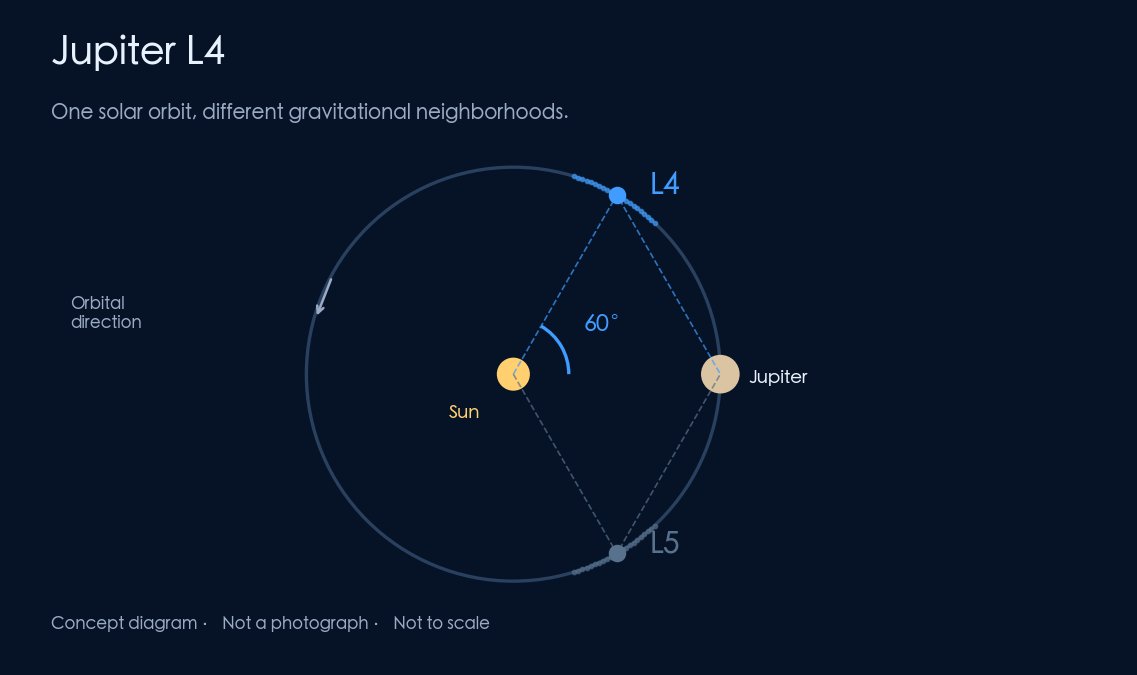
Jupiter L4 is a Lagrange point of the Sun–Jupiter system, about 60° ahead of Jupiter in its orbit. The marker identifies this reference location and nearby Trojan region. There is no physical surface or planetary shell.
What is a Lagrange point?
In an idealized model of two large bodies orbiting their common center of mass, five locations allow a suitably moving small object to retain a fixed relative configuration. These Lagrange points, L1 through L5, result from gravity and orbital motion; gravity does not vanish there.
L1, L2, and L3 lie on the Sun–Jupiter line. L4 leads Jupiter by about 60° and L5 trails by about 60°, each forming an equilateral triangle with Sun and planet.
Small deviations near L1–L3 tend to grow. L4 and L5 are relatively stable in the ideal Sun–Jupiter model, allowing nearby oscillating orbits. Other bodies perturb the real system, so stable does not mean motionless forever.
Why do asteroids stay nearby?
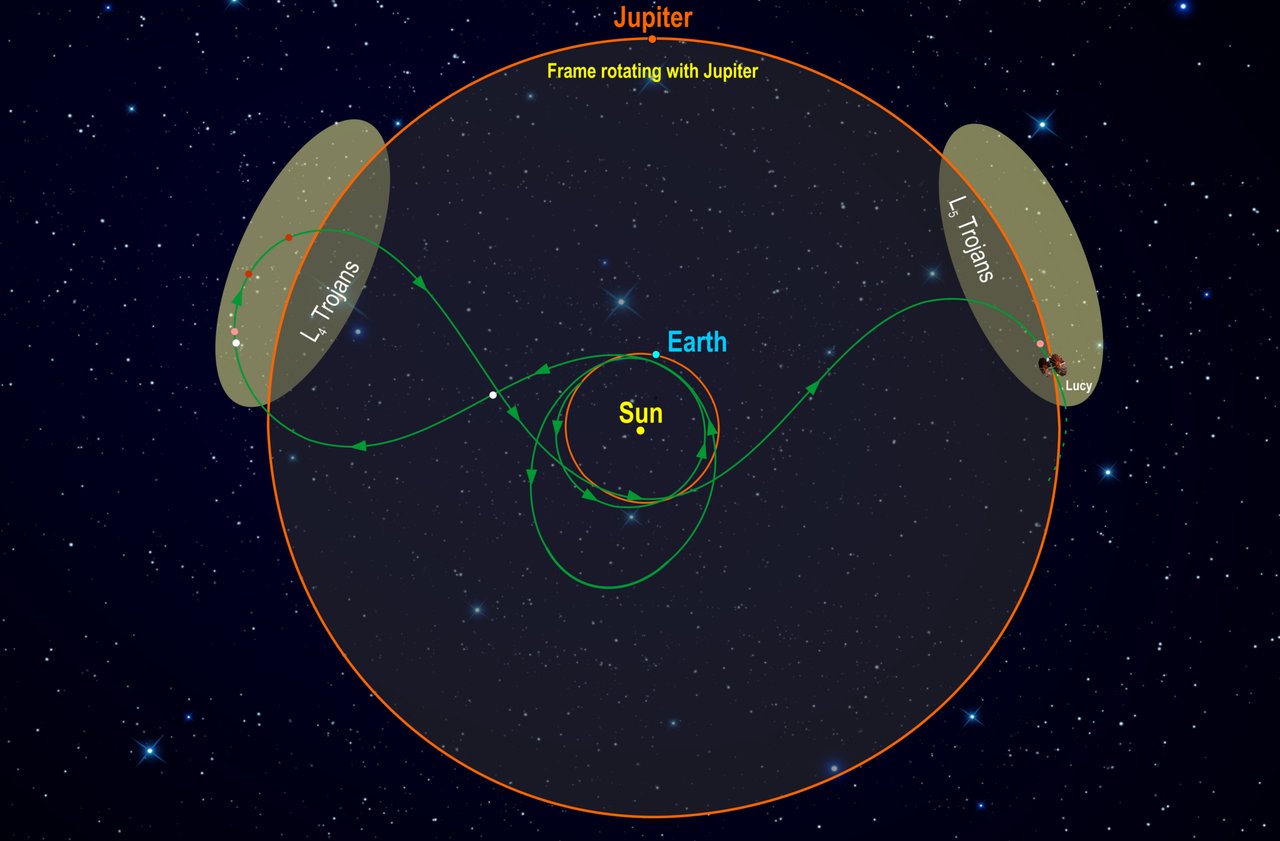
In a frame rotating with Jupiter, suitable trajectories remain near the stable regions for long periods. Trojans are neither free from gravity nor crowded into one mathematical point.
Do Trojans orbit the Sun or Jupiter?
They orbit the Sun with a period similar to Jupiter’s. They are spaced runners on a shared track rather than little Jovian moons. Real trajectories include inclination and oscillation; neat circles are explanatory diagrams.
What will Lucy visit?
L4 targets include Eurybates, Polymele, Leucus, and Orus, scheduled for flybys in 2027–2028. Different colors and sizes support comparisons of early materials.
Why is there no diameter?
L4 is a reference position, and the surrounding swarm has no hard boundary. A body diameter would mislead. The marker instead helps locate nearby asteroids within the solar system.