Lucy: visiting the solar system’s childhood
The first mission to Jupiter’s Trojan asteroids launched in October 2021. Its 12-year journey is designed to fly past eight asteroids and study fossils of the solar system’s formation.
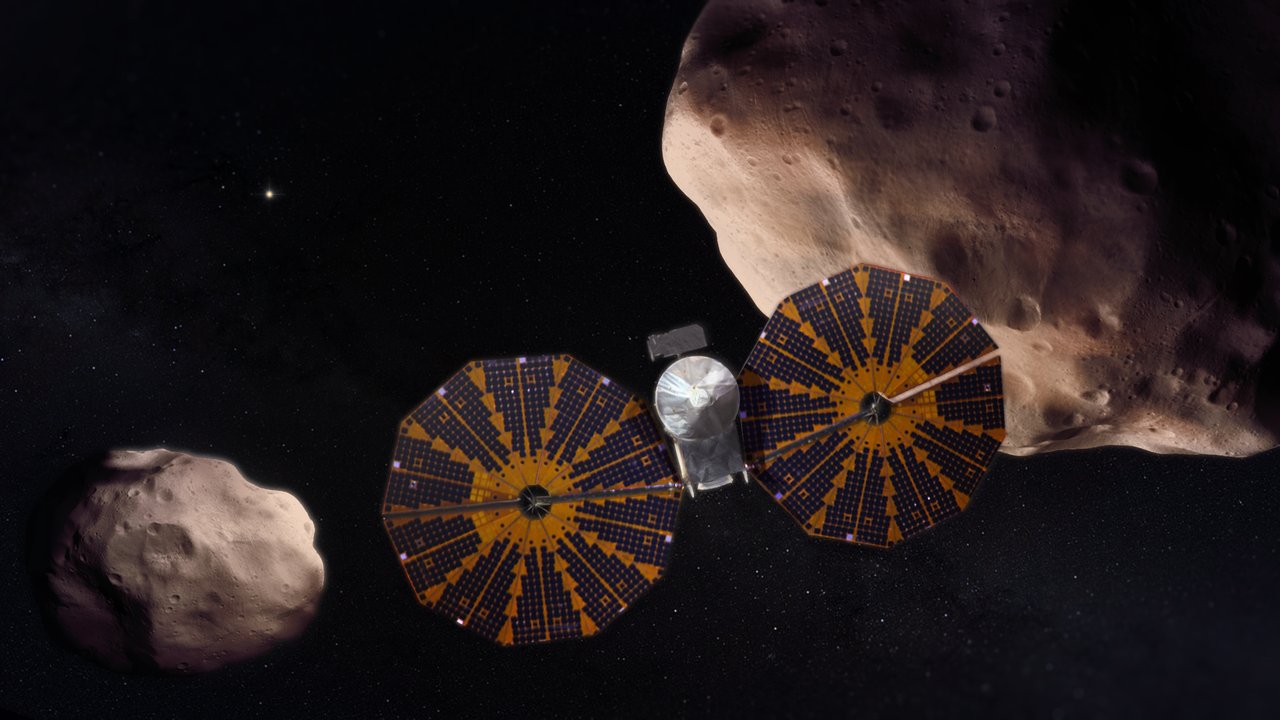
How can one spacecraft visit eleven widely separated small worlds? Lucy repeatedly uses Earth’s gravity to reshape its orbit. Launched on October 16, 2021, it is the first dedicated mission to Jupiter’s Trojans, with current plans covering eleven asteroids in the main belt and Trojan populations.
Named after a fossil
Lucy honors the 3.2-million-year-old Australopithecus afarensis fossil found in Ethiopia in 1974. As that fossil changed understanding of human evolution, the mission aims to illuminate the solar system’s childhood. The fossil’s name came from the Beatles song Lucy in the Sky with Diamonds, lending the spacecraft an additional musical connection.
An intricate route
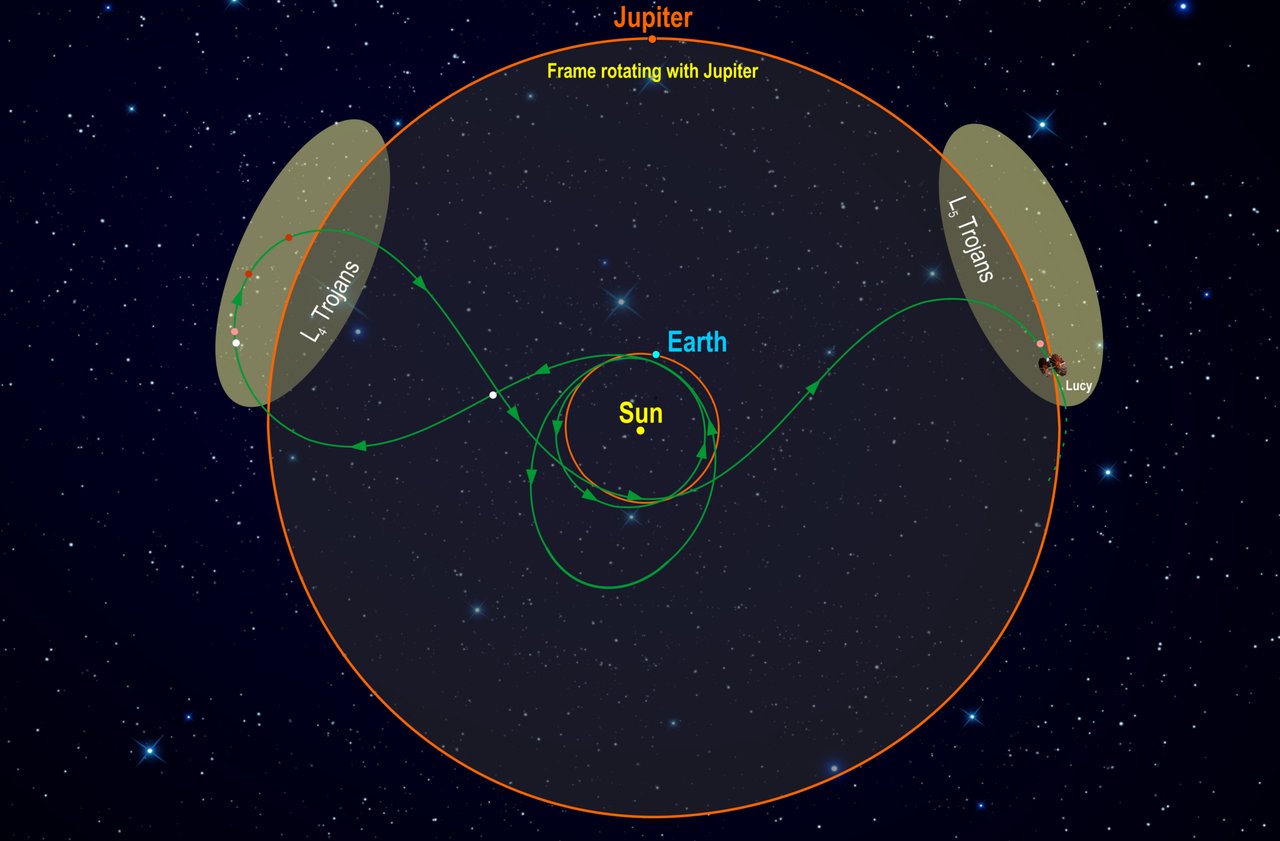
Launched on Atlas V, Lucy uses three Earth flybys to reach both the leading and trailing Trojan swarms. The approximately 6.4-billion-kilometer journey includes two main-belt rehearsal encounters. Repeated assists make this multi-target itinerary possible without impractical fuel loads.
Fossils of planetary formation
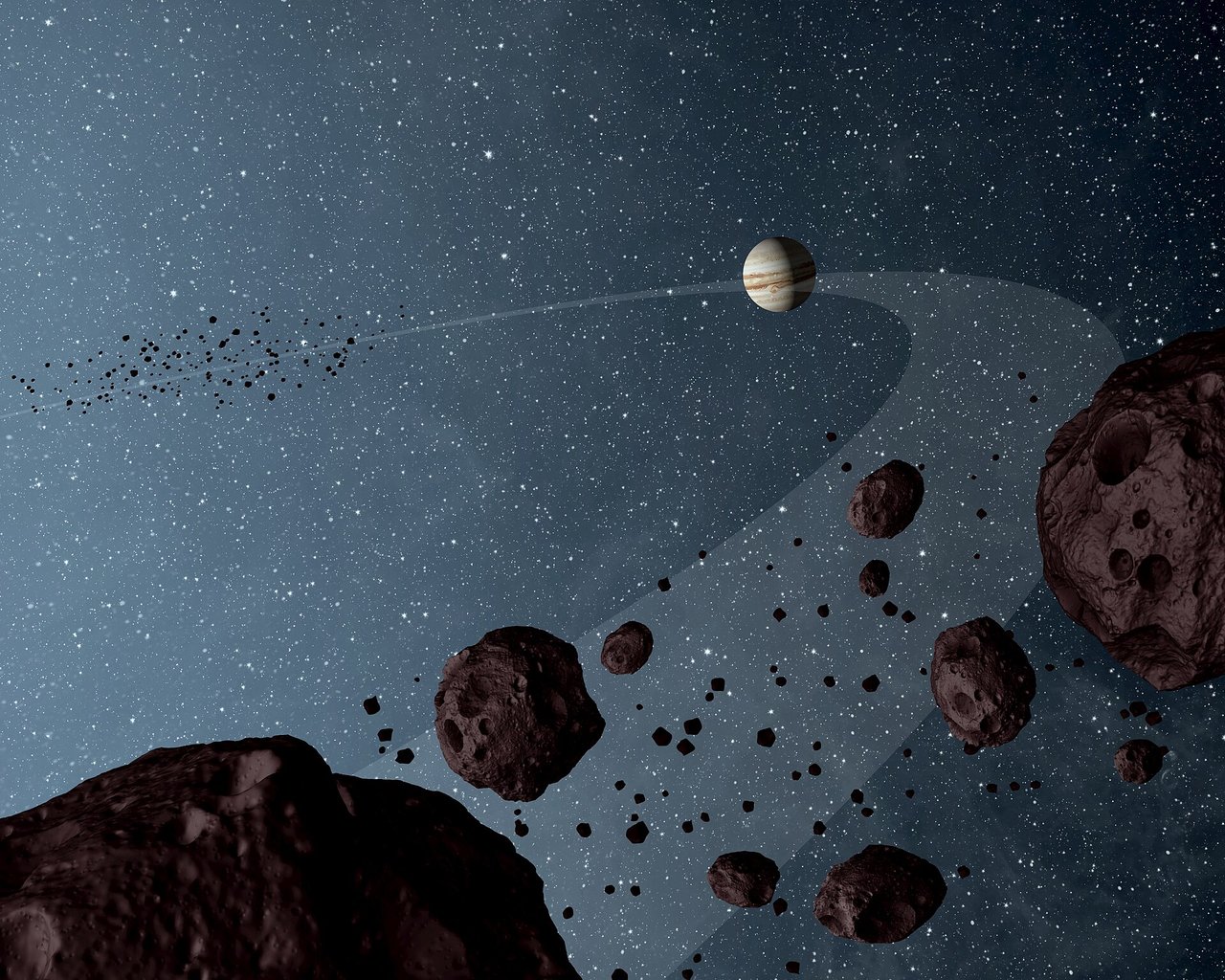
Trojans gather near the L4 and L5 Lagrange regions, about 60° ahead of and behind Jupiter. They may be primordial planetesimals trapped during early giant-planet migration. Different colors and compositions suggest origins in different regions, allowing scientists to reconstruct how planets formed and moved.
Spacecraft and instruments
Built by Lockheed Martin, Lucy has two circular arrays each 7.3 m across and a total span over 14 m. At about 5.7 AU, they provide only around 500 W. A pointing platform carries L’LORRI high-resolution imaging, L’Ralph color and infrared spectroscopy, L’TES thermal spectroscopy, and two T2CAM tracking cameras.
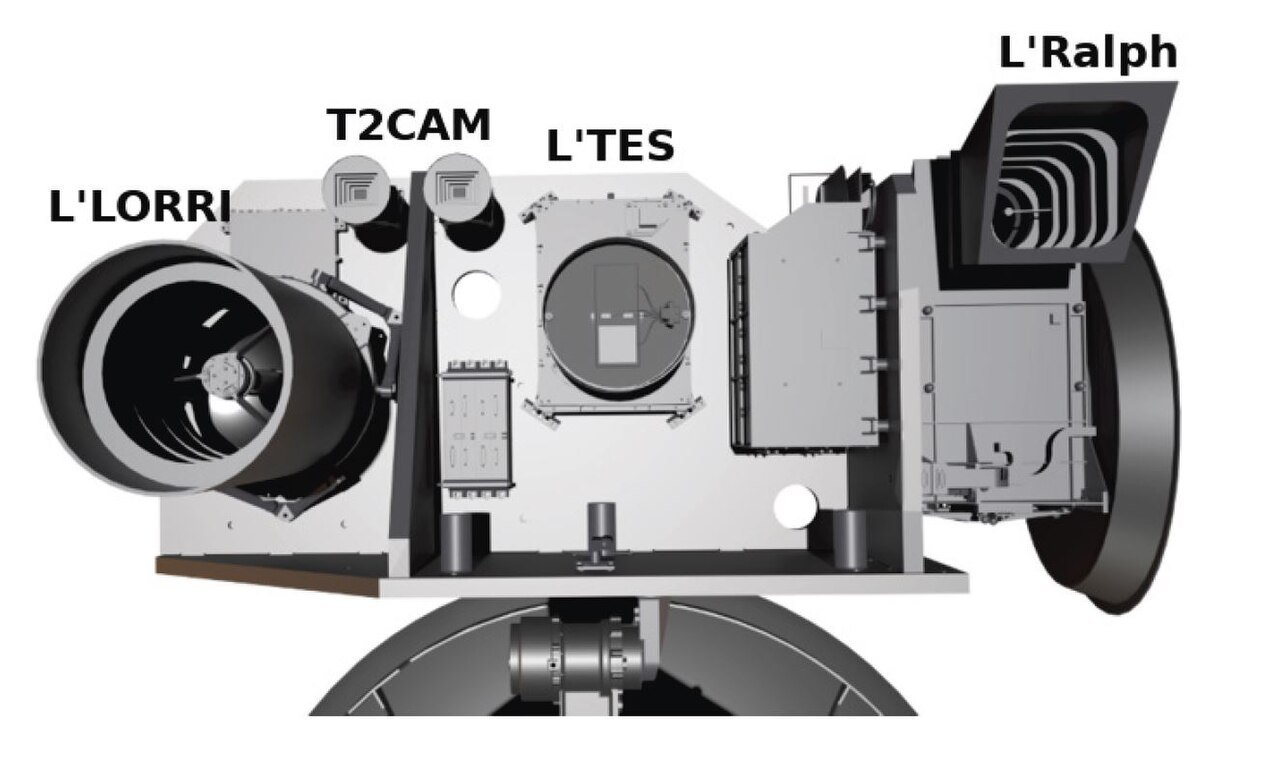
Why fly past rather than orbit each target?
Stopping, orbiting, and departing repeatedly would require far too much fuel. A carefully aimed flyby can still measure surface detail, color, temperature, and mass-related effects. With signals taking tens of minutes to reach Earth, the spacecraft must autonomously track targets and execute rehearsed observations.
Visited and upcoming targets
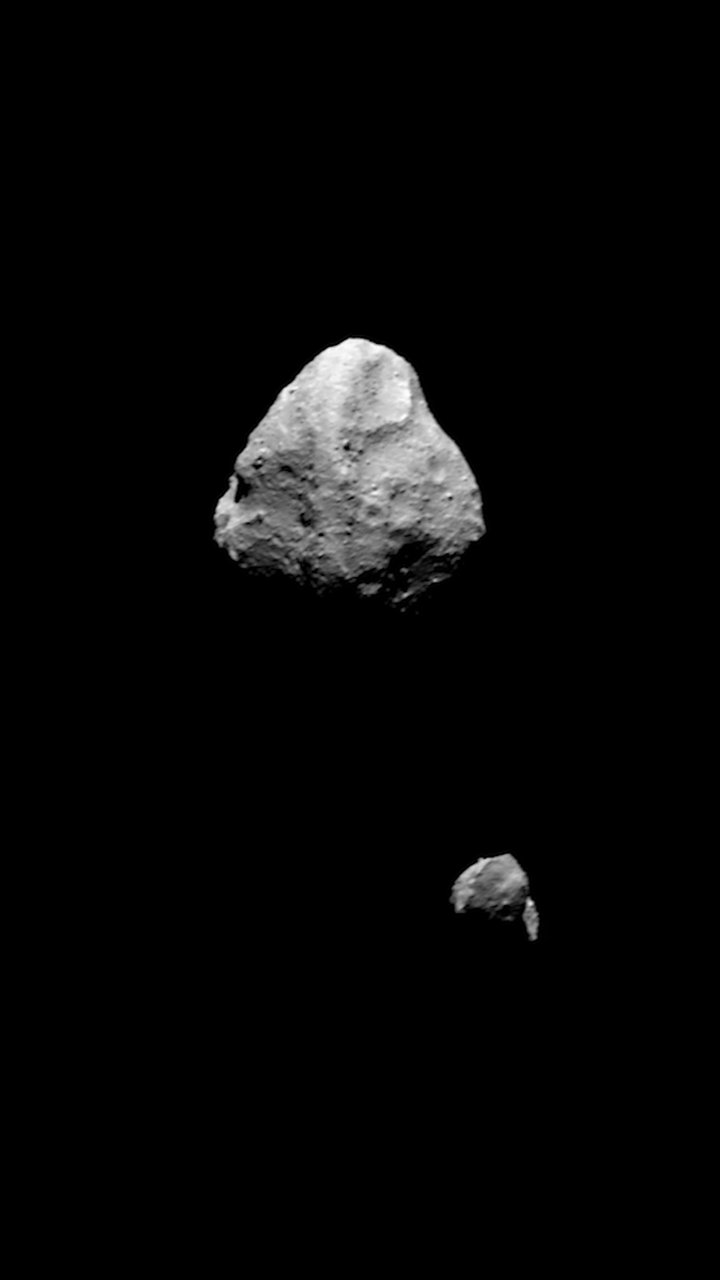
In November 2023, Lucy passed Dinkinesh and discovered its small, contact-binary moon Selam. In April 2025 it visited elongated Donaldjohanson. Current plans include Eurybates, Polymele, Leucus, and Orus in 2027–2028, followed by the Patroclus–Menoetius binary in March 2033. Future encounters depend on spacecraft health and navigation.
3D model source
The app adapts Lucy by murilo.kleine, licensed CC BY 4.0, retaining attribution, source, and license. This 2019 concept model is described by its author as not scientifically exact. It has been simplified, compressed, and adapted for display; scale and initial attitude are illustrative rather than telemetry-derived.
Gold, champagne, and cool-toned presentation materials and soft reflections improve readability without claiming exact real-world colors.