Makemake: a frozen world with a hidden moon
The Kuiper Belt’s second-brightest dwarf planet after Pluto has a reflective methane-ice surface. Its faint moon MK2 was announced in 2016. Makemake is named after the creator deity of Rapa Nui mythology.
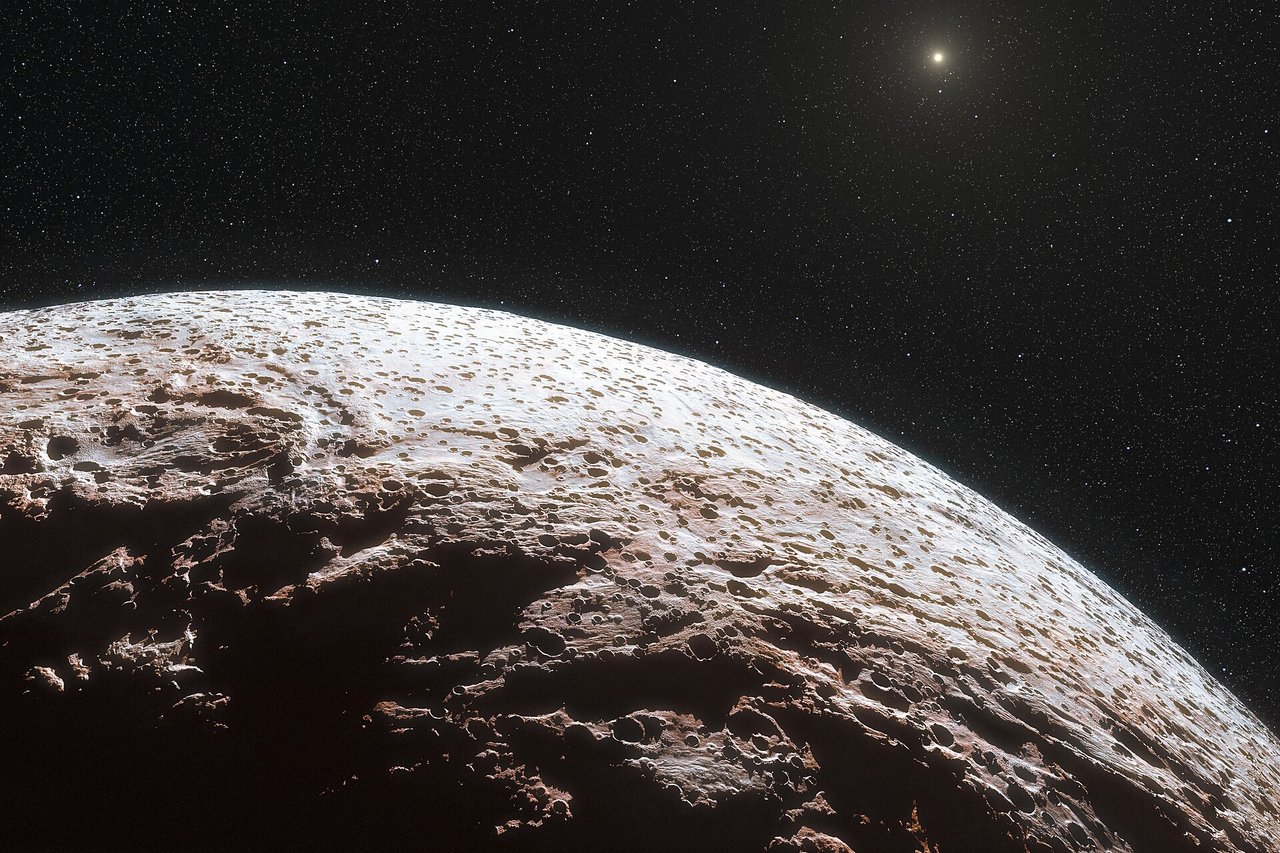
On Makemake, the Sun is a dazzling point above methane ice hundreds of degrees below freezing. About 1,430 km across, it is one of the brighter Kuiper Belt dwarf planets. A small moon hidden in its glare was announced in 2016.
A bright distant world
Mike Brown’s team discovered it at Palomar on March 31, 2005, initially designated 2005 FY9. At around magnitude 17, it can be accessible to advanced amateur equipment. Its average solar distance is 45.8 AU, with a period of about 306 years and aphelion near 53 AU.
Methane ice on the surface
Its albedo around 0.8 indicates a very reflective surface. Methane ice dominates, with ethane and some nitrogen. Radiation-produced organic compounds may explain a reddish tint. Temperatures are around 30–40 K, roughly −240°C.
A rocky core and icy mantle?
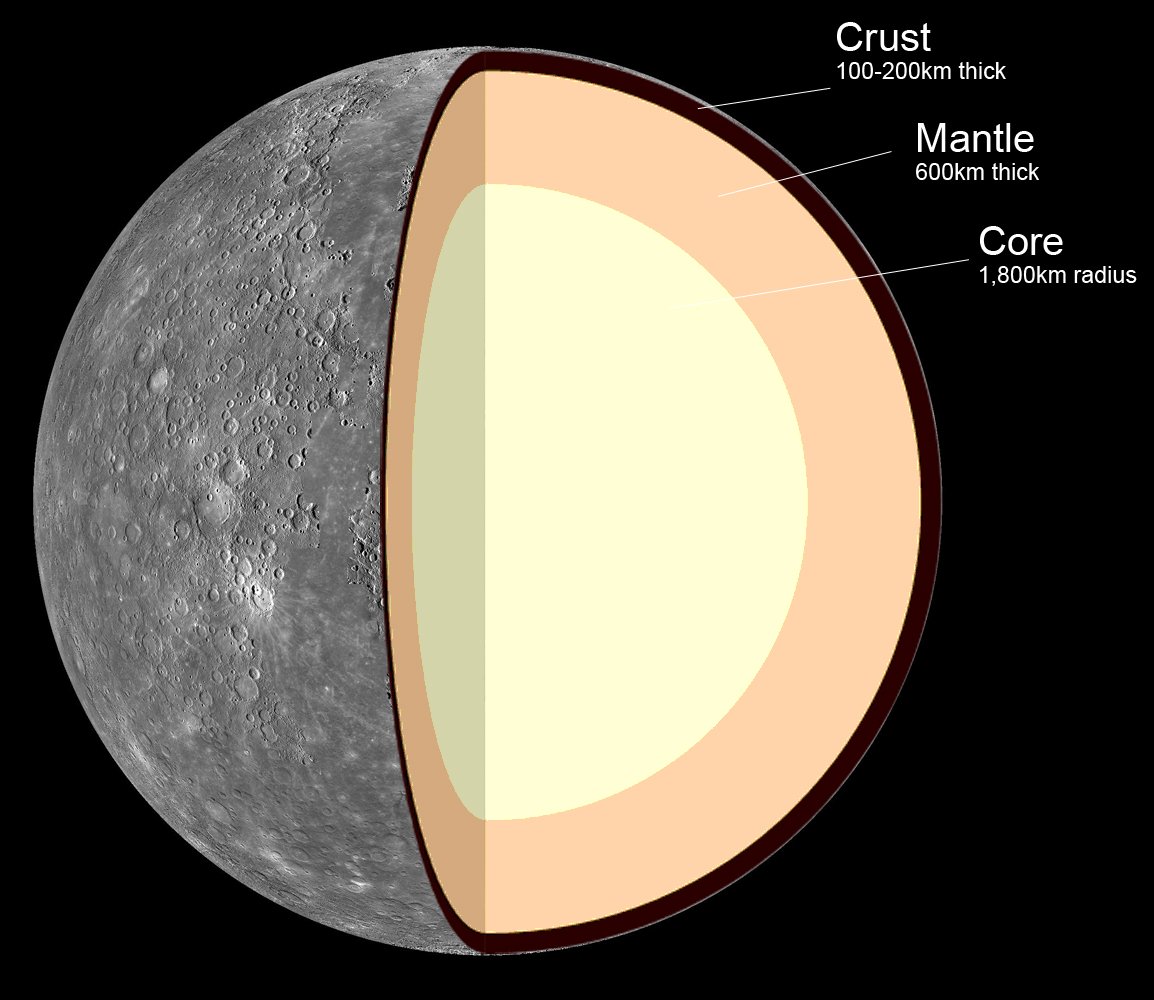
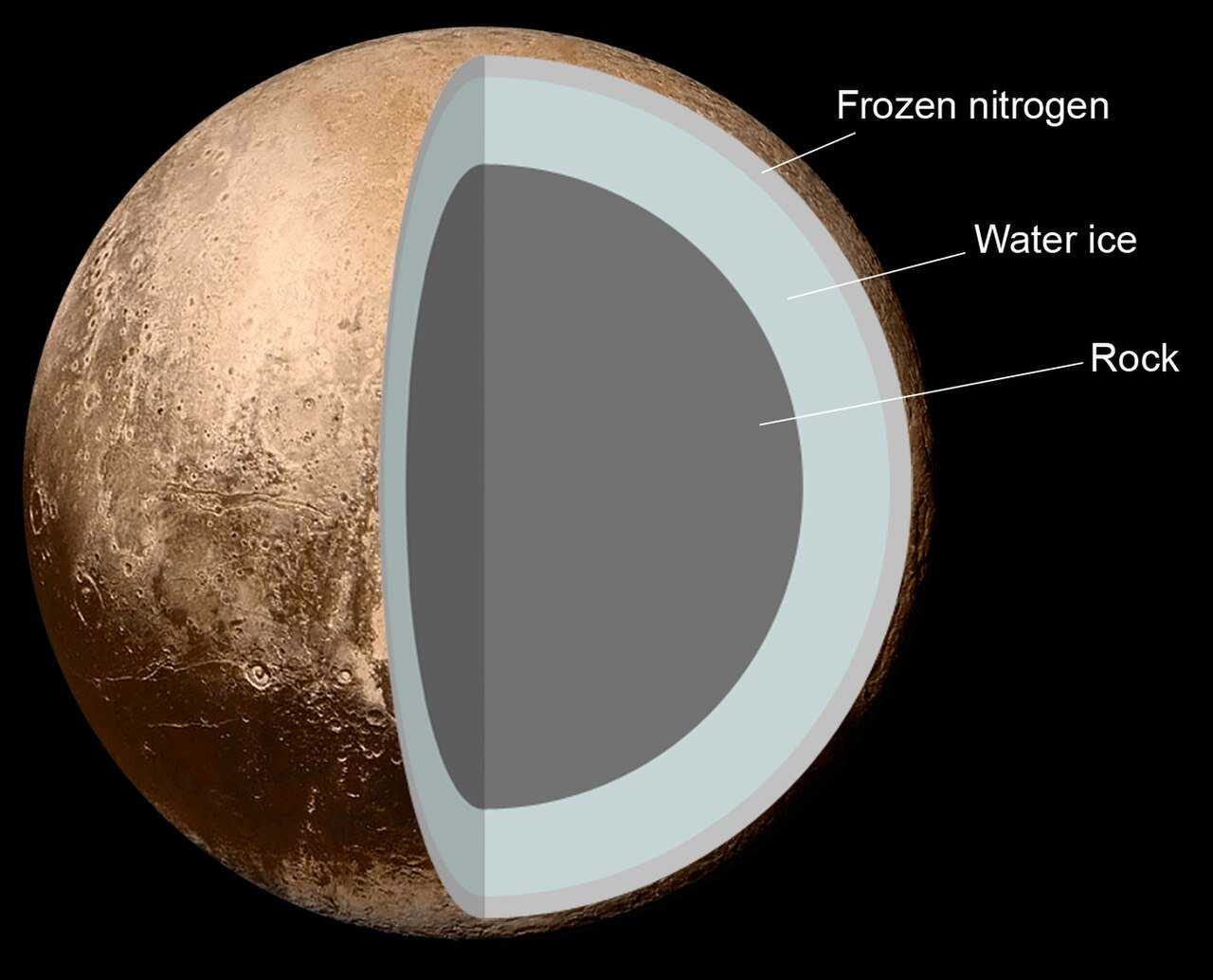
Its interior has never been directly observed. Occultation and density estimates suggest a differentiated rock–ice world, with a rocky center, water-ice mantle, and volatile frost. A density estimate around 1.7 g/cm³ implies substantial proportions of both rock and ice. The diagram below uses Pluto as an analogy, not a measured Makemake cross-section.
MK2, the hidden moon
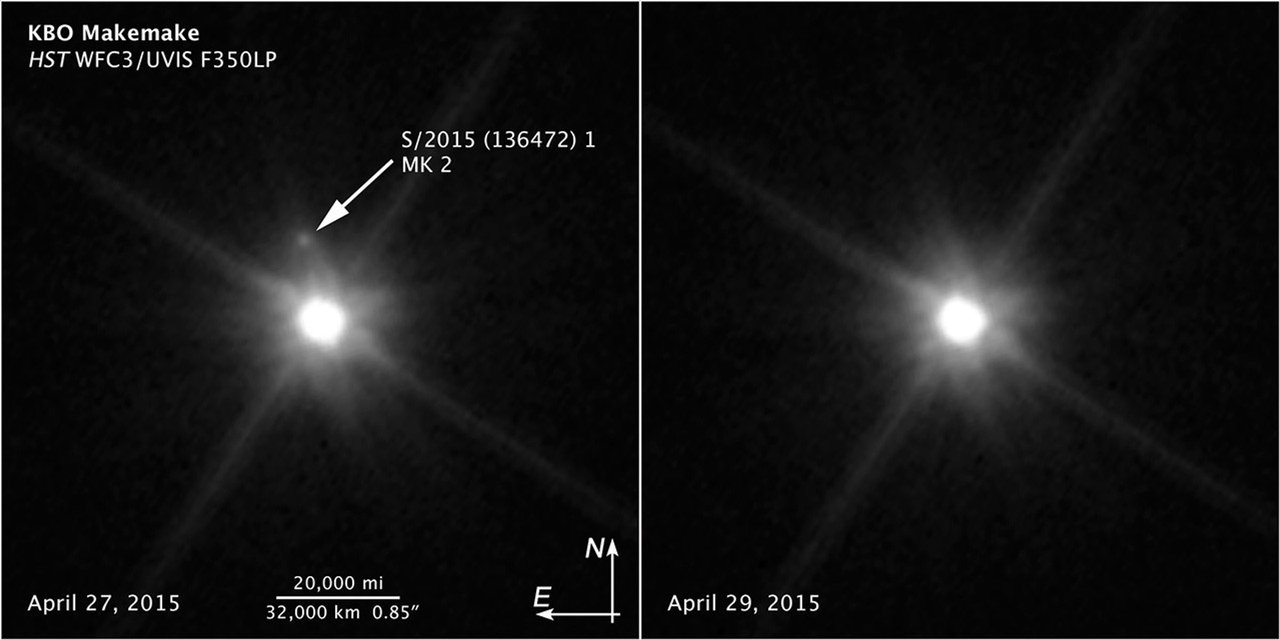
In April 2016, astronomers announced a moon in Hubble images taken the previous year. Officially S/2015 (136472) 1, nicknamed MK2, it is roughly 175 km wide and about 1,300 times fainter than Makemake. Measuring its orbit will improve estimates of the primary’s mass and density.
A Rapa Nui name
Discovered just after Easter 2005, it was initially nicknamed Easterbunny. The IAU named it Makemake after the Rapa Nui creator deity in 2008, also recognizing it as a dwarf planet.
Is there breathable air?
No. Any gas from sublimating methane is extremely thin and cannot supply oxygen. Weak gravity and cold prevent an Earth-like atmosphere. The sky would remain nearly black, and exploration requires oxygen, thermal protection, and tolerance for long communications delays.
Does it occasionally breathe?
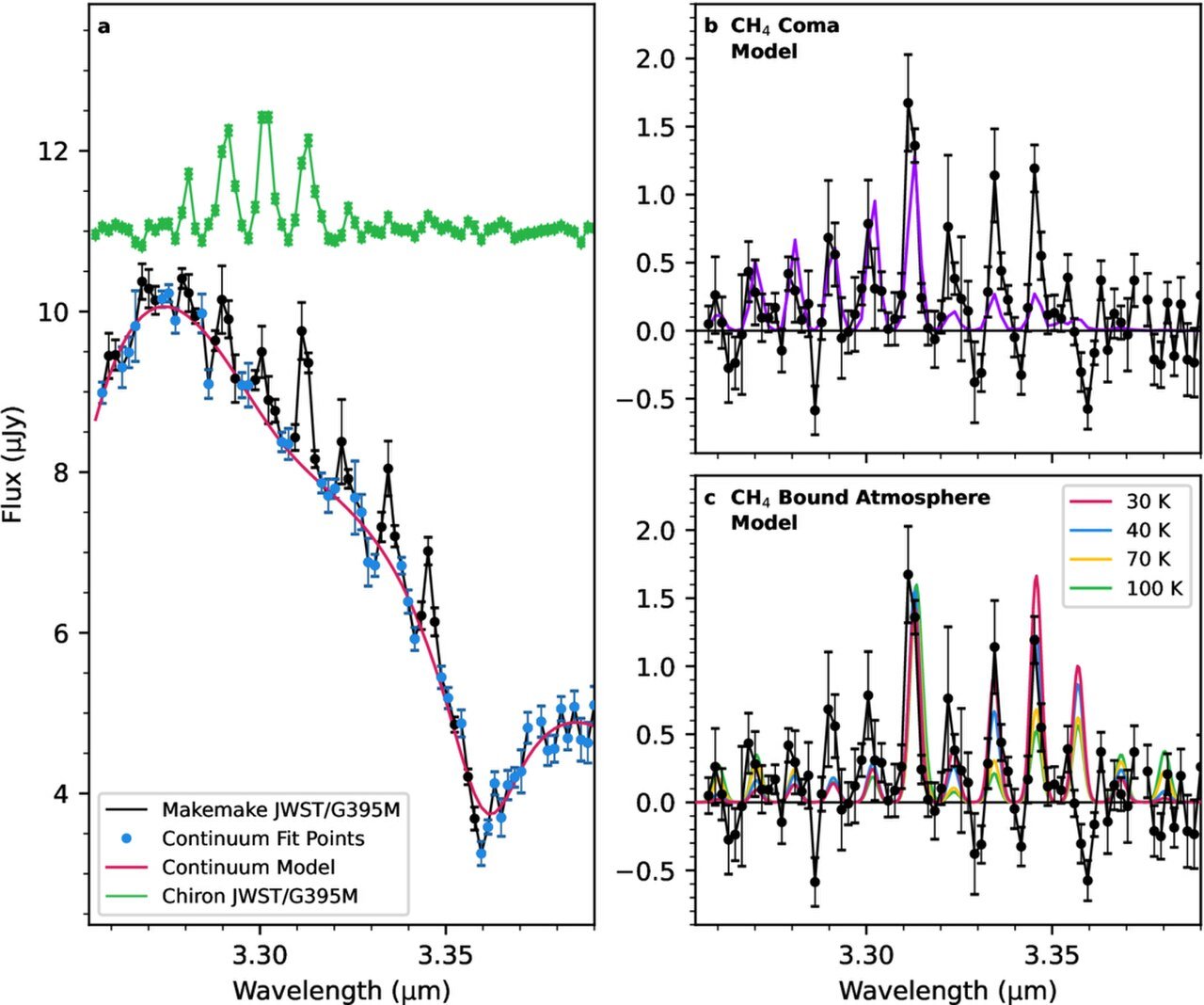
A 2011 occultation found no Pluto-like global atmosphere. Webb observations reported in 2025 detected methane gas emission, suggesting localized sublimation, a temporary thin atmosphere, or possible comet-like activity. Further observations are needed.