Queta: a tiny moon found by Hubble
Finding a faint point beside a bright asteroid takes patience. That little point can help scientists weigh the entire system.
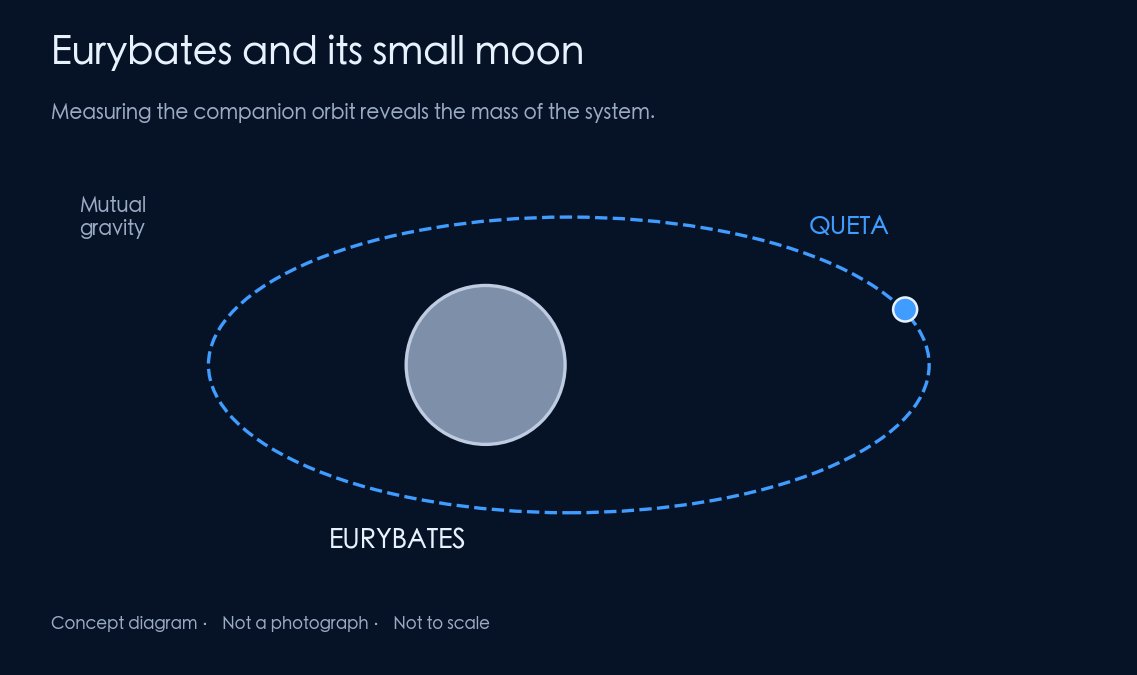
Queta is a tiny moon beside distant Eurybates, faint enough to hide in the primary’s glare—like spotting a small insect beside a streetlamp from across a road.
Why isn’t one bright point enough?
Noise, background stars, and stray light can imitate a moon. Repeated Hubble images established that the point persisted and moved with the asteroid rather than appearing by chance.
Weighing the larger partner
Orbital distance and speed constrain system mass. Combined with the primary’s volume, they reveal density. Low density may indicate lighter material or pores. A little companion’s path reveals otherwise invisible clues inside.
Why does Lucy care?
Knowing Queta exists lets planners aim cameras at the right search region and compare shape, color, and motion with the primary. The encounter is planned for 2027, subject to mission status.
What does it look like?
Size and orbit have estimates, but surface details await close observation. Attractive diagrams should not imply certainty. Queta illustrates how repeated evidence turns a possible point into a world we can study.