Saturn: what are those beautiful rings?
Saturn’s rings look like a solid record, but consist of countless pieces of ice and rock. It is the only planet with a mean density lower than water and has a hexagonal storm pattern near its north pole.
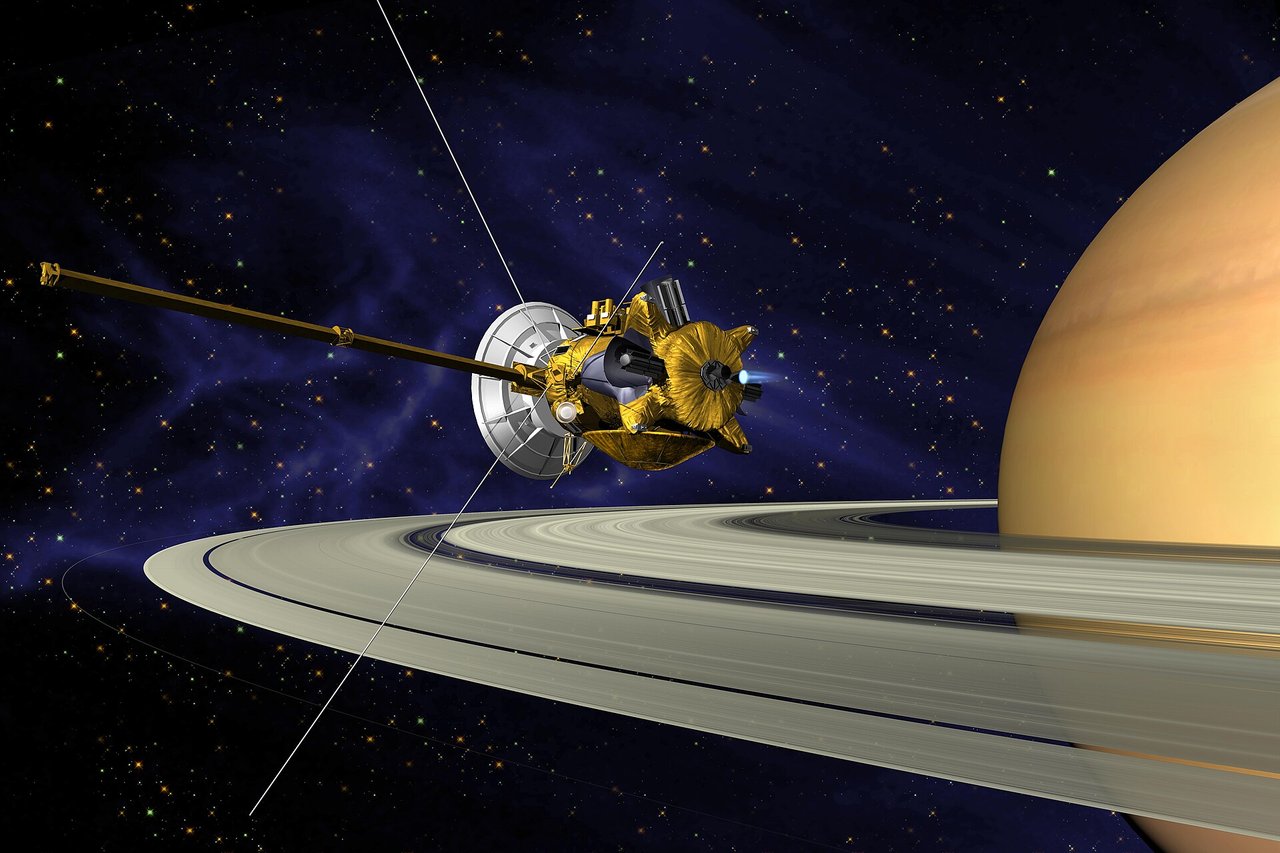
Saturn’s silhouette is instantly recognizable: broad rings like an extraordinarily thin hat brim. The sixth and second-largest planet has an equatorial diameter around 120,500 km, averages roughly 1.4 billion km from the Sun, and orbits in about 29.4 years.
Rings of ice
The rings consist mainly of water-ice particles with some rock, ranging from dust to large blocks. The main C, B, and A rings are separated by gaps, including the roughly 4,700 km Cassini Division between A and B. Beyond lie the narrow F ring and broad E ring.
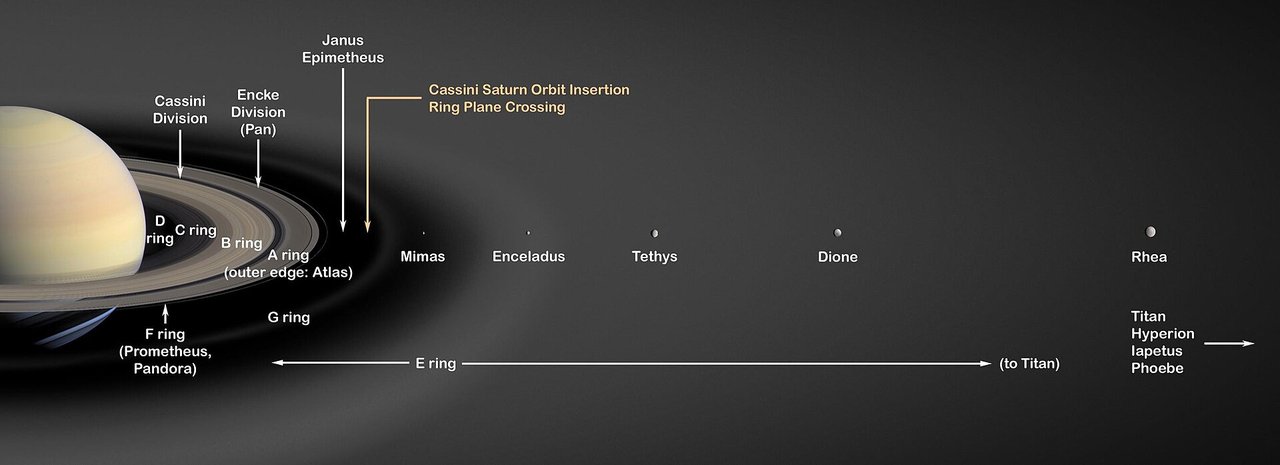
The main rings span over 200,000 km yet are only tens of meters thick in many places. They may include disrupted icy moons or comets and reprocessed ancient material. Dust and mass estimates suggest ages from hundreds of millions of years to much older origins; the question remains open.
Could you stand on a ring?
No. Particles orbit independently with space between them; there is no continuous floor. Dense reflected sunlight makes them look solid from afar. A spacecraft could cross a sufficiently clear region but could not land on a ring surface.
Less dense than water
Saturn is mostly hydrogen and helium, with no solid surface. Its average density is about 0.687 g/cm³, the only planet below water’s density. The familiar floating-in-a-giant-ocean comparison illustrates density rather than a realistic experiment. Cloud tops are around −178°C, and a rotation under eleven hours produces an equatorial bulge.
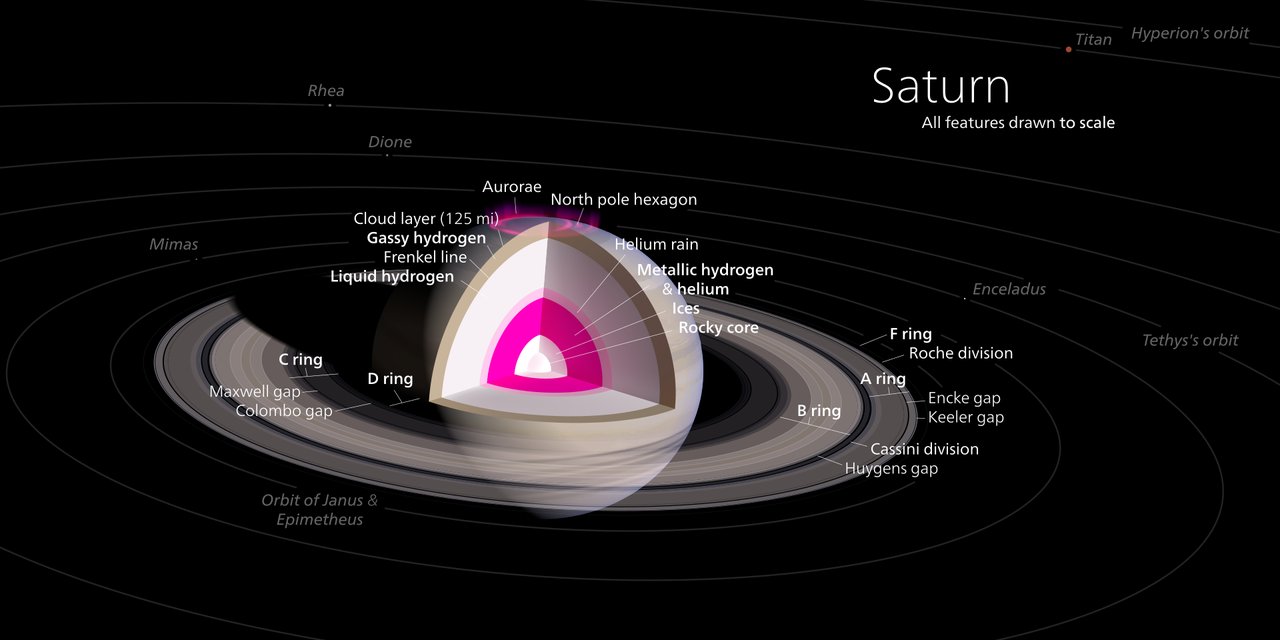
Pressure increases inward from ammonia-ice clouds to liquid and metallic hydrogen, surrounding a rock- and ice-rich interior. Sinking helium droplets may help explain why Saturn emits more energy than it receives from sunlight.
The north-polar hexagon
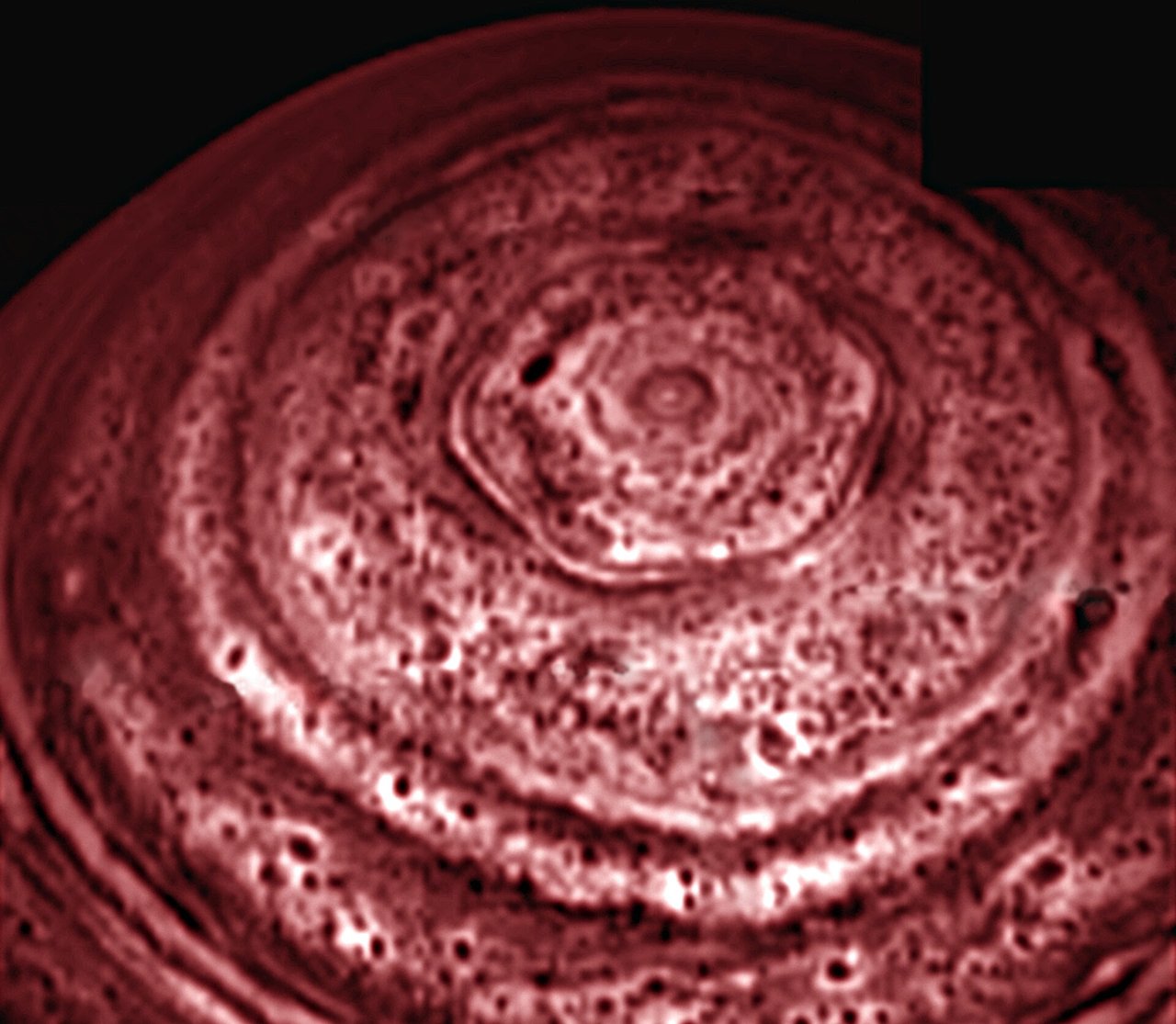
Voyager discovered a giant hexagonal pattern in the early 1980s; Cassini studied it for years. Roughly 30,000 km across, it surrounds the pole in a fast jet stream, with winds over 300 km/h. Interacting flows maintain its unusual shape, still an active research topic.
Thirteen years of Cassini–Huygens
Launched on October 15, 1997, Cassini entered Saturn orbit on July 1, 2004. Huygens landed on Titan on January 14, 2005, the most distant spacecraft soft landing.
Over thirteen years, Cassini completed nearly 300 orbits and returned over 600,000 images. Its 2017 Grand Finale included 22 passes between planet and rings, ending in a controlled atmospheric entry on September 15 to protect potentially habitable moons.
A remarkable moon family
By 2025, 274 moons had been confirmed. Titan is about 5,150 km across with a dense atmosphere and methane lakes. Enceladus’s plumes feed the E ring from an ocean beneath its ice. Two-toned Iapetus and crater-dominated Mimas each offer entirely different worlds.