Selam: a moon made of two touching lobes
One small moon, two joined lobes. It shows that worlds do not always need violent collisions to come together.

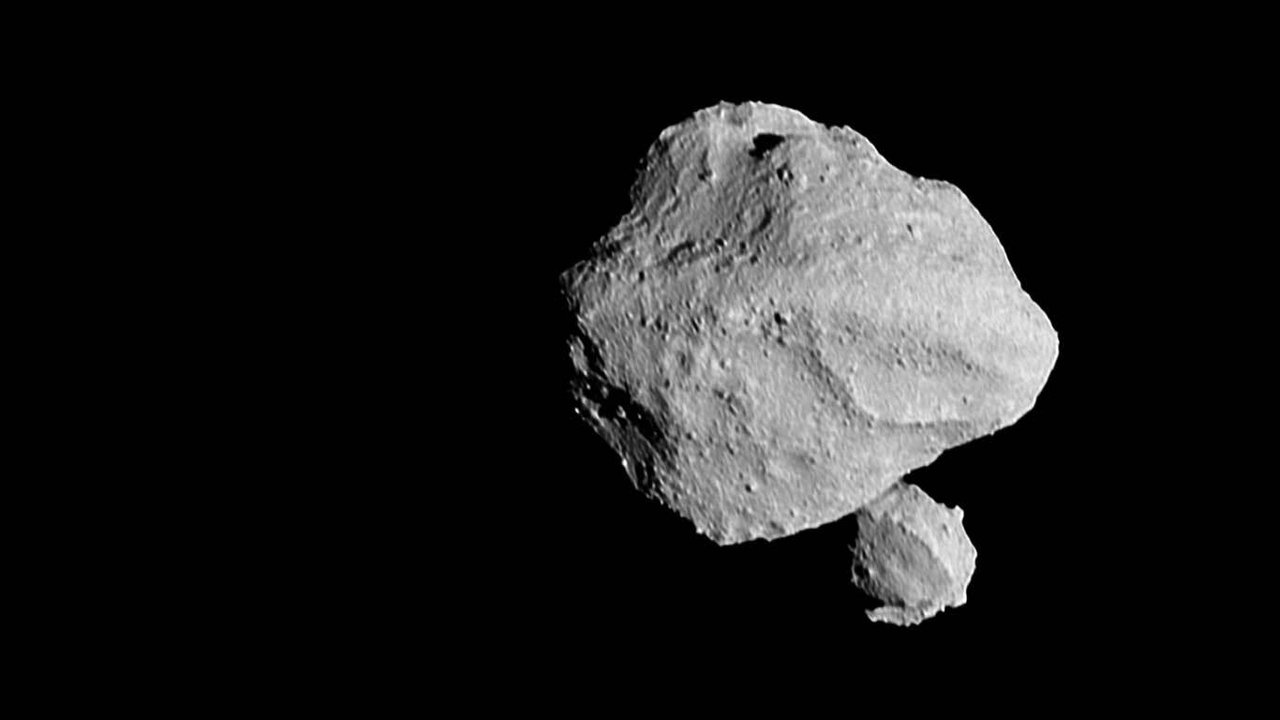
Imagine our Moon as two touching potatoes, orbiting an Earth only hundreds of meters wide. Selam has roughly that unusual relationship to Dinkinesh. It is both a natural satellite and a contact binary whose lobes rotate together.
Why didn’t the first image show both lobes?
One lobe can hide the other from some angles. Only when Lucy moved around the system did the double outline become clear. A single silhouette can conceal a three-dimensional story.
How did the lobes join?
One possibility is that material shed by the primary assembled nearby and later met at low speed. Why two similarly sized lobes formed and retained their outlines remains a modeling problem. Images constrain the history but cannot replay it.
A small moon can weigh a system
Orbital period and scale reveal mass through gravity. Combined with shape, they constrain density and internal porosity. The same laws work for tiny systems and large ones.
What does it share with our Moon?
Both are natural satellites, despite very different origins, dimensions, and environments. Satellite describes an orbital relationship, not a shape. The universe does not require moons to be round.