Deimos: Mars’s tiny potato-shaped companion
Mars’s smaller, outer moon is only about 12 km across and covered in a thick layer of dust. It may be a captured asteroid; from the Martian surface it looks like a slowly moving bright star.
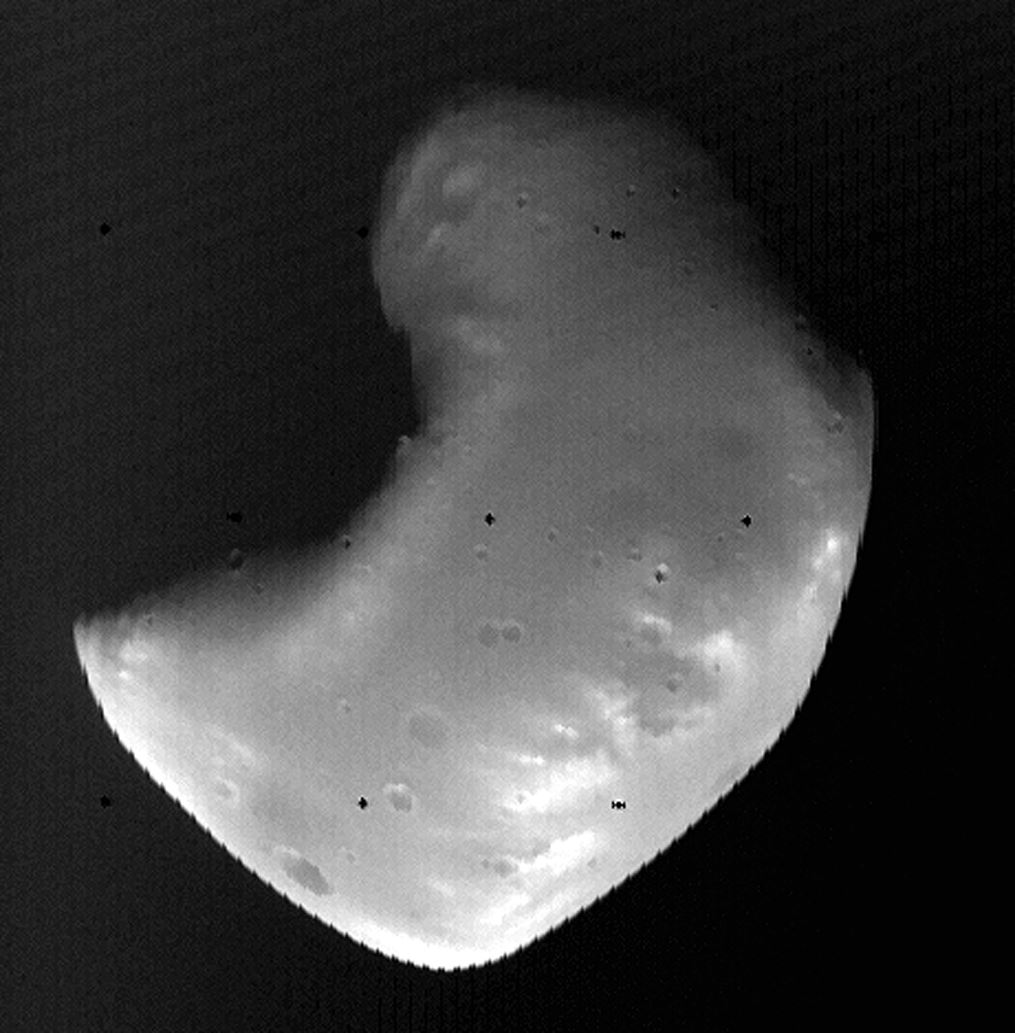
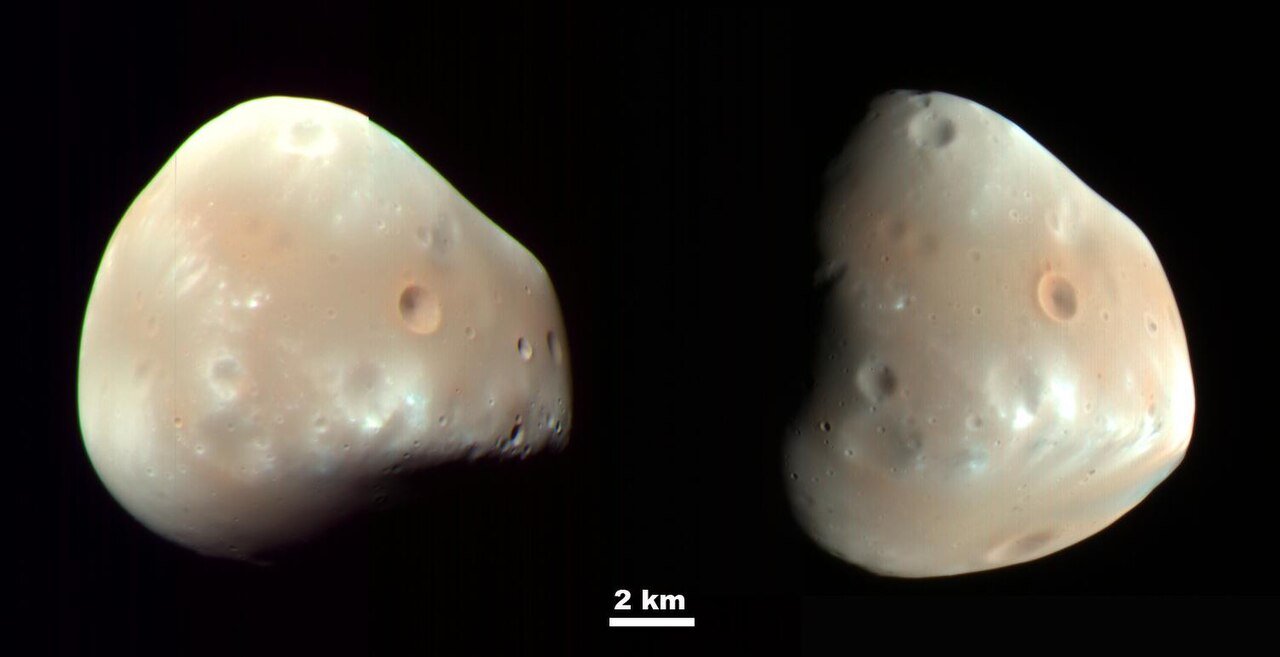
Deimos would fit within a large city: its mean diameter is only about 12.4 km. Mars’s smaller, outer moon is an irregular, dusty potato-shaped body.
Mars’s smallest moon
Asaph Hall discovered Deimos in August 1877 at the US Naval Observatory, days before discovering Phobos. Its name comes from the Greek mythological figure representing fear.
It orbits about 23,460 km from Mars’s center in 30.3 hours, slightly longer than the Martian day. Unlike inward-moving Phobos, Deimos is very slowly moving outward. Its distant future also depends on solar and other gravitational influences.
A blanket of dust
Thick regolith, accumulated from impacts, softens crater rims and makes Deimos smoother than Phobos.
Its two formally named craters, Swift and Voltaire, are about 2 km wide, honoring writers who imagined two Martian moons before their discovery.
Shape and interior
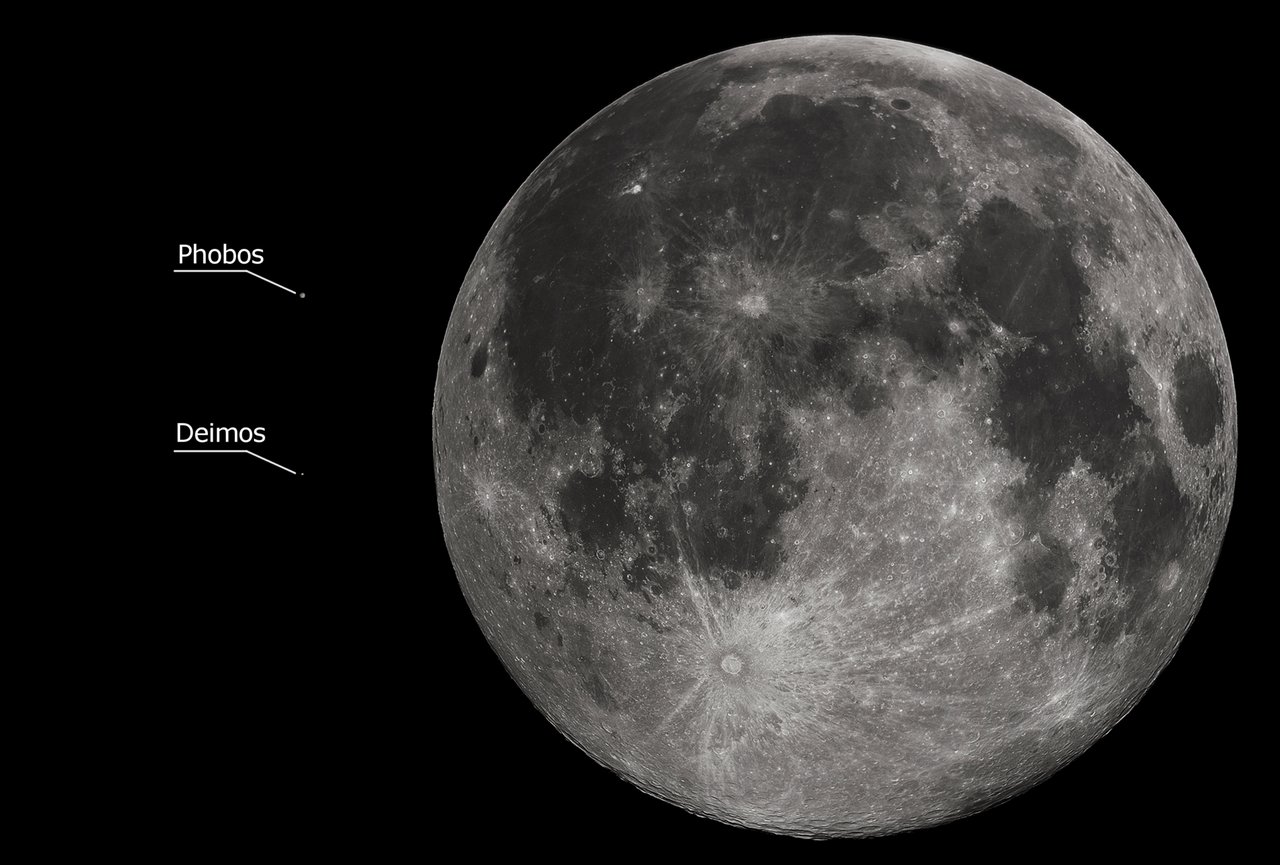
Its dimensions are roughly 15 × 12 × 11 km, tiny beside our Moon.
A density around 1.47 g/cm³ suggests pores, loosely assembled rubble, or perhaps ice. Gravity is about one three-thousandth of Earth’s; escape speed is roughly 5.6 m/s, low enough for a strongly thrown ball to escape. It has no protective atmosphere or magnetic field, and temperatures are around −40°C.
A captured asteroid?
Its dark color, low albedo near 0.07, and spectrum resemble C- or D-type asteroids, suggesting capture. An alternative is formation from debris ejected by a giant impact on Mars.
Close observations by the UAE’s Hope spacecraft in 2023 suggested surface materials may resemble Martian rock, adding to the debate. Future samples may decide the issue.
Does it look like our Moon from Mars?
It appears as a bright point, only about two arcminutes across, far smaller than our full Moon. Because its orbital period is only a little longer than Mars’s rotation, it moves slowly: roughly 2.7 Earth days from rise to set, rising again about every 5.5 days. It quietly crosses the desert sky rather than providing brilliant moonlight.