Jupiter: a storm that lasts for centuries
Jupiter could hold about a thousand Earths but has no solid ground to stand on. Its stripes are fast-moving cloud bands, and its Great Red Spot is a giant storm that has persisted for centuries.
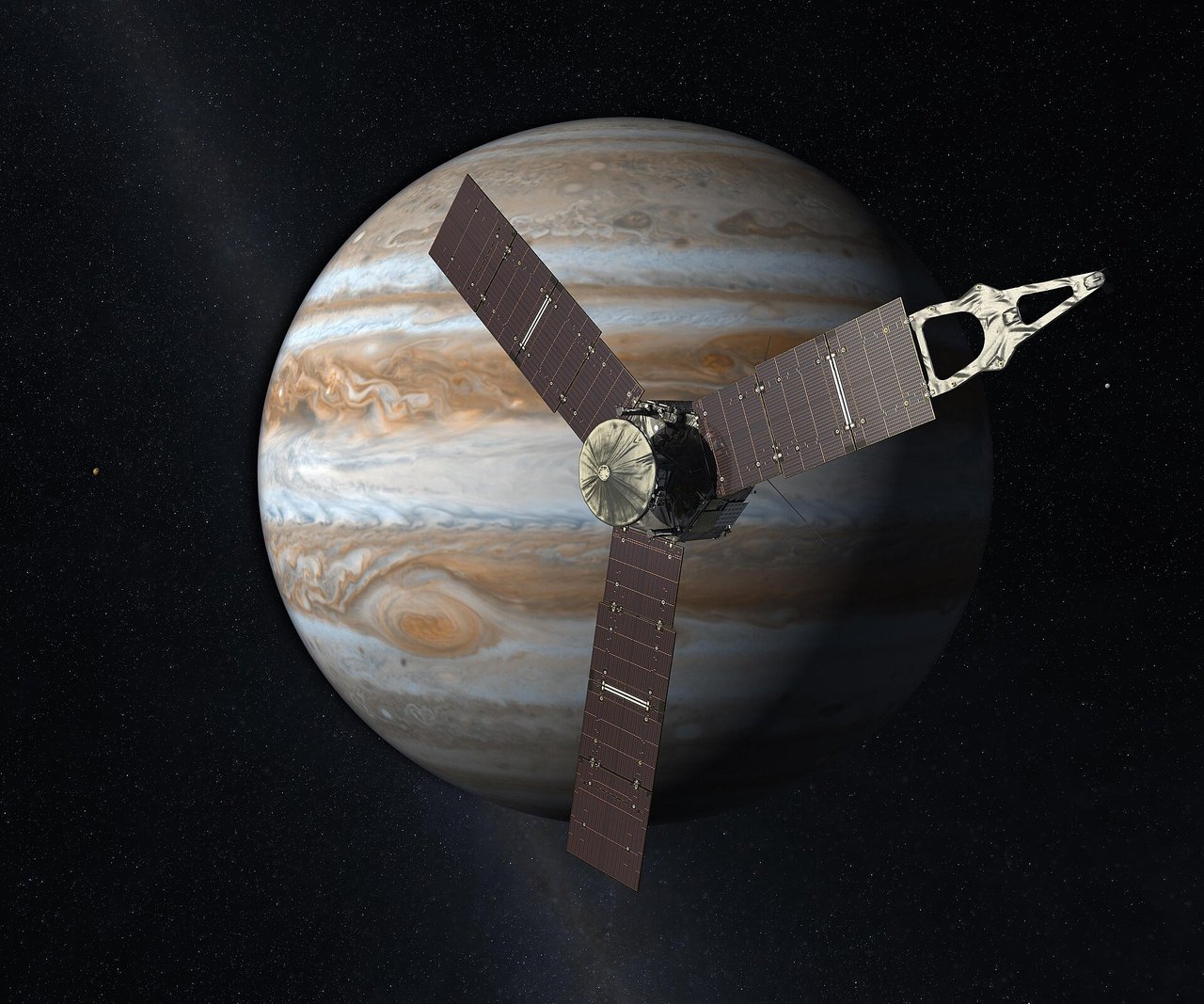
Jupiter’s volume could contain over 1,300 Earths. Its diameter is about 139,820 km and its mass roughly 2.5 times that of the other seven planets combined. It orbits at about 5.2 AU in 11.86 years, with no solid surface but a Great Red Spot and a vast moon family.
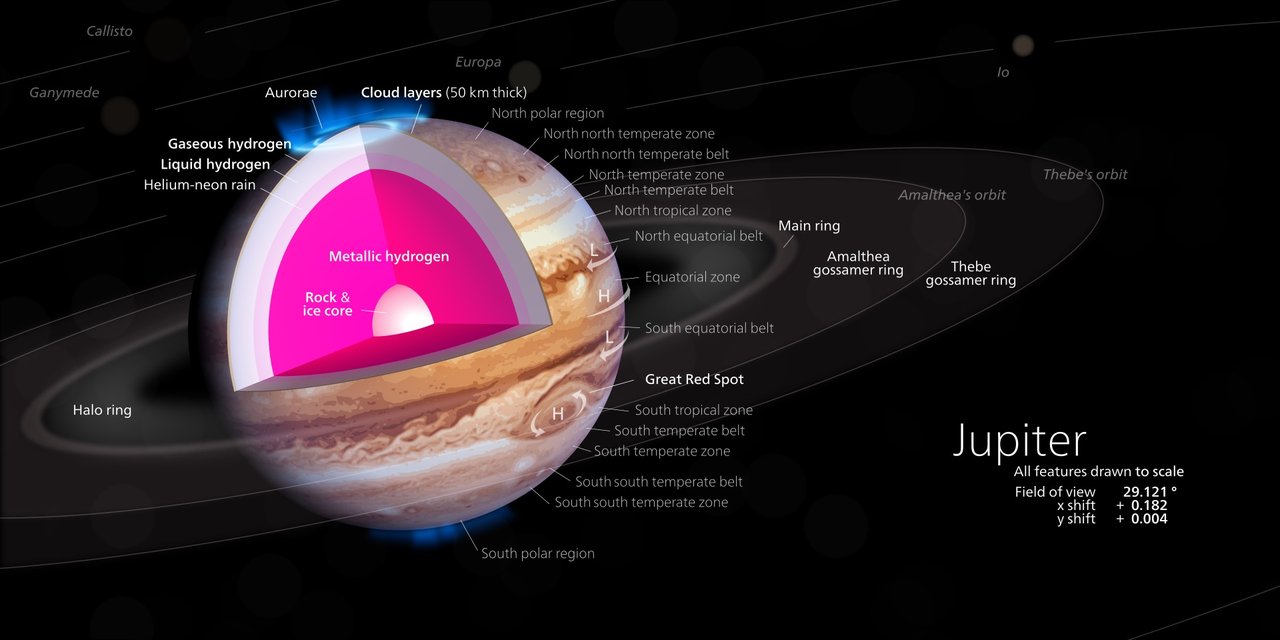
Inside a gas giant
Below the cold cloud tops lie hydrogen and helium, with traces of methane and ammonia. Increasing pressure turns hydrogen into dense fluid and then electrically conducting metallic hydrogen. Its motion generates the strongest planetary magnetic field. Juno suggests a diffuse heavy-element core rather than a sharply bounded solid sphere. Jupiter shares the Sun’s main ingredients but lacks the mass for stellar fusion.
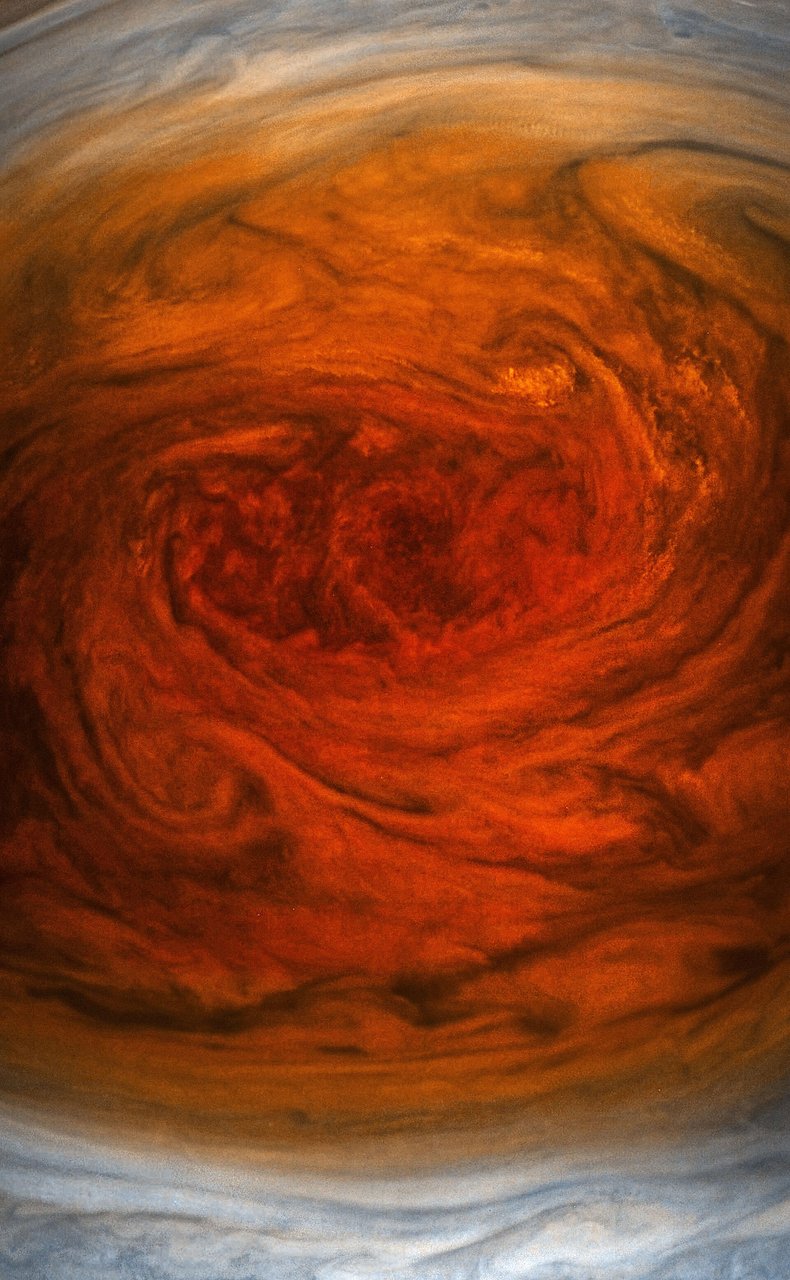
The Great Red Spot
This anticyclonic storm is larger than Earth, roughly 16,000 km across east to west, with edge winds exceeding 400 km/h. Its observational history extends back centuries. Recent measurements show it shrinking while some edge winds strengthen; its future is uncertain.
Could a spacecraft land there?
There is no Mars-like ground. A descending craft enters progressively hotter, denser fluid until pressure and heat overwhelm it. Galileo’s atmospheric probe returned about an hour of data in 1995 before it stopped—not because it struck a surface.
The Galilean moons
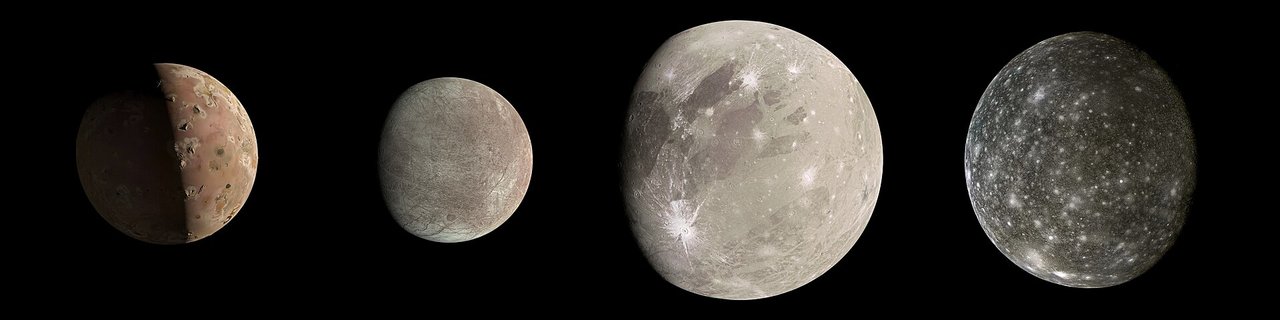
Galileo’s discovery of four large moons in 1610 challenged the idea that everything circled Earth. Io is volcanic, Europa may have an ocean, Ganymede is 5,268 km across with its own magnetic field, and Callisto preserves ancient craters. More than ninety Jovian moons have been confirmed.
From Galileo to Juno
Pioneer and Voyager flybys supplied early close views in the 1970s. Galileo arrived in December 1995 as the first orbiter and delivered the only atmospheric probe. It was deliberately sent into Jupiter in 2003 to avoid contaminating Europa. Juno entered polar orbit on July 4, 2016 to map gravity and magnetism, study polar storms, and visit moons; NASA still lists it as active in 2026. Europa Clipper is expected in 2030 and JUICE in 2031.
A gravitational traffic controller
Jupiter ejects some comets and asteroids, redirects others, and receives impacts itself. Shoemaker–Levy 9 struck it in 1994, leaving enormous dark scars. Calling Jupiter a simple gravitational shield is misleading: it can both reduce and increase inward traffic. It also shapes Kirkwood gaps and gathers Trojan populations ahead and behind its orbit.