Miranda: a patchwork world
Cliffs, grooves, and geometric terrain crowd this small moon. Why does a world only a few hundred kilometers across have such a complicated face?
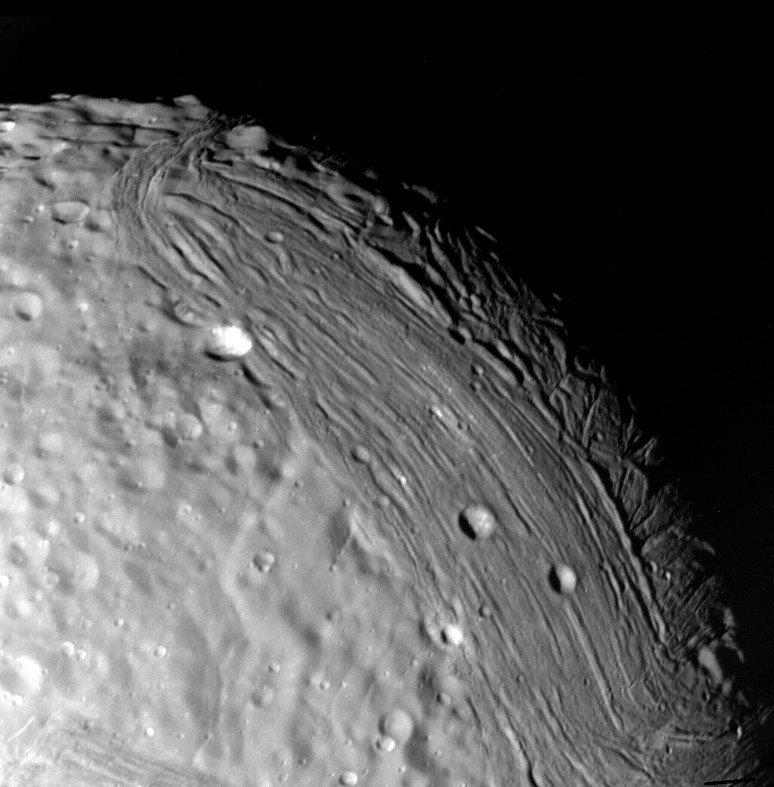
Miranda is a small Uranian moon with a patchwork surface: old cratered ground, grooves, ridges, and sharply bounded regions, like maps from several worlds pasted together.
How did a small moon make such large terrain?
Tidal heating and internal motion are possible mechanisms. Changing orbital relationships alter gravitational stresses. Under pressure and over geological time, ice can flow rather than remain rigid like an ice cube.
Was it shattered and rebuilt?
That is a historical hypothesis, not a confirmed origin story. More securely, the surface underwent several episodes of modification. Researchers compare terrain ages, structures, and interior models to explain the full set of features.
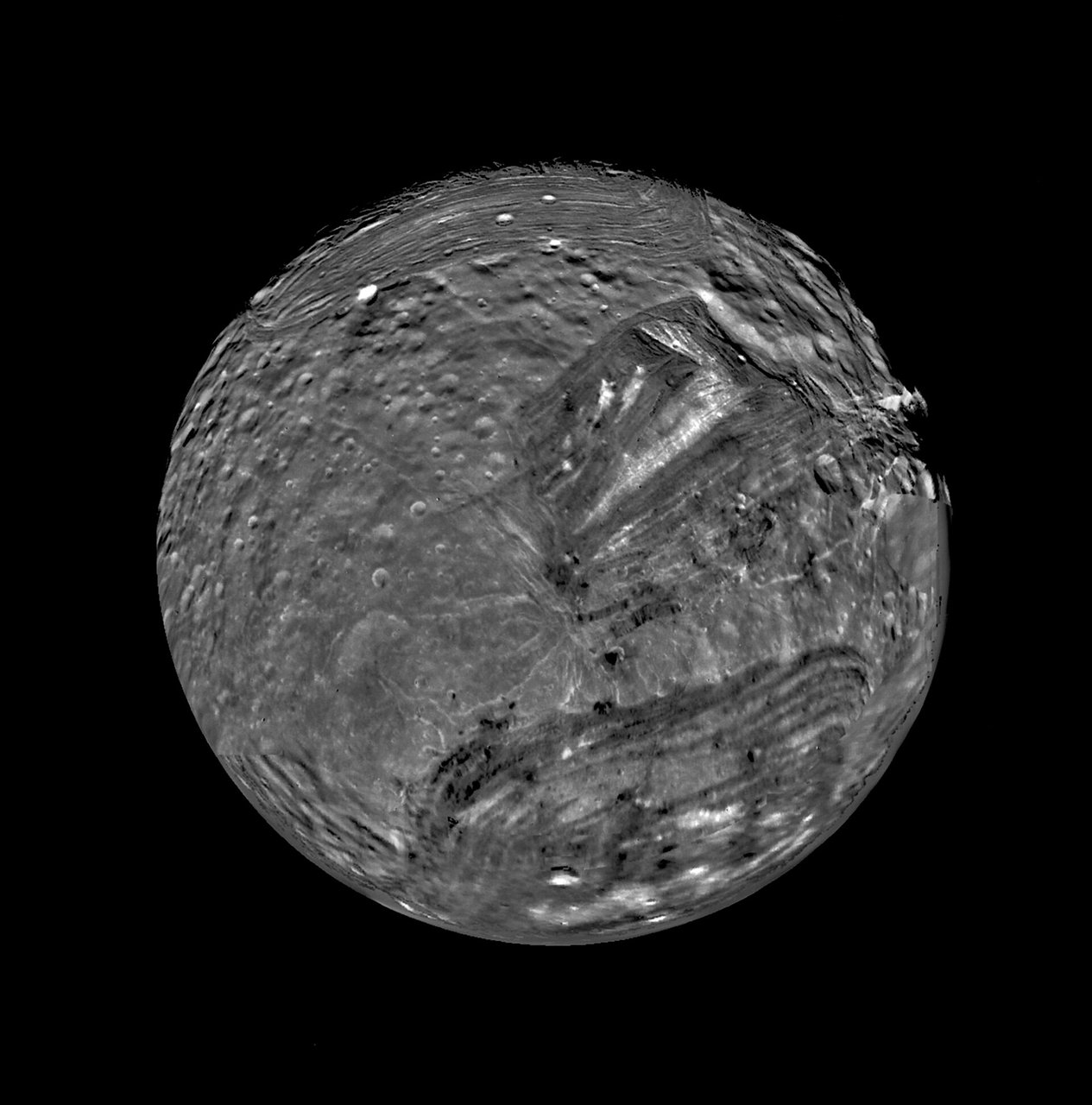
How extreme are the cliffs?
Verona Rupes is often cited among exceptional solar-system landforms, but height estimates depend on viewing geometry, and gravity is much weaker than Earth’s. More useful than a dramatic falling-time claim is the lesson that small icy moons can record enormous fractures.
What pictures are missing?
Voyager 2’s brief 1986 encounter did not cover the entire globe. Future missions must fill many gaps. Miranda is an album intriguing enough after only a few pages.