Ganymede: a moon larger than Mercury
At 5,268 km across, the solar system’s largest moon exceeds Mercury in size and has its own intrinsic magnetic field. Beneath its ice may lie more liquid water than in all Earth’s oceans. ESA’s JUICE is scheduled to enter orbit around it in December 2034.
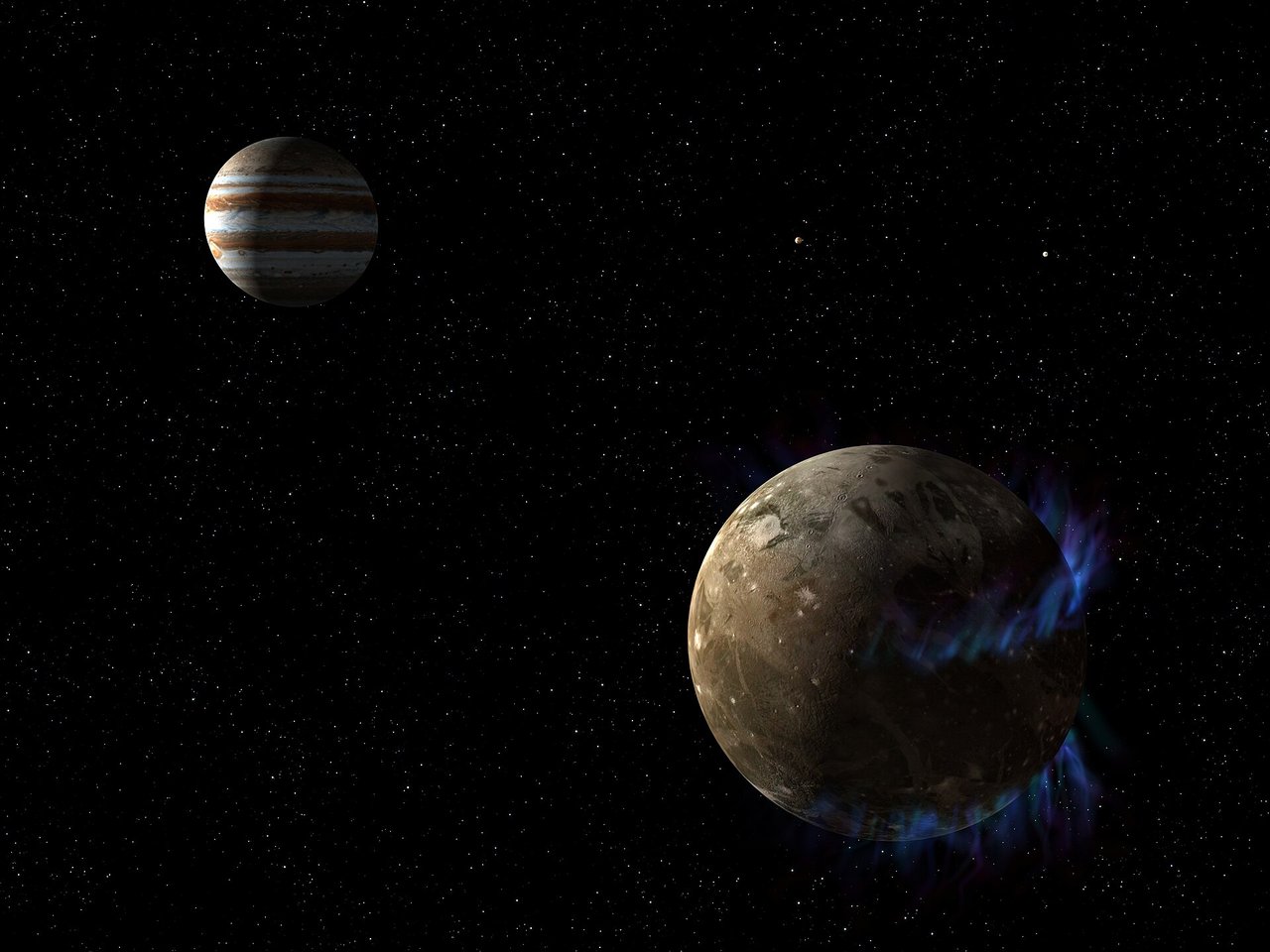
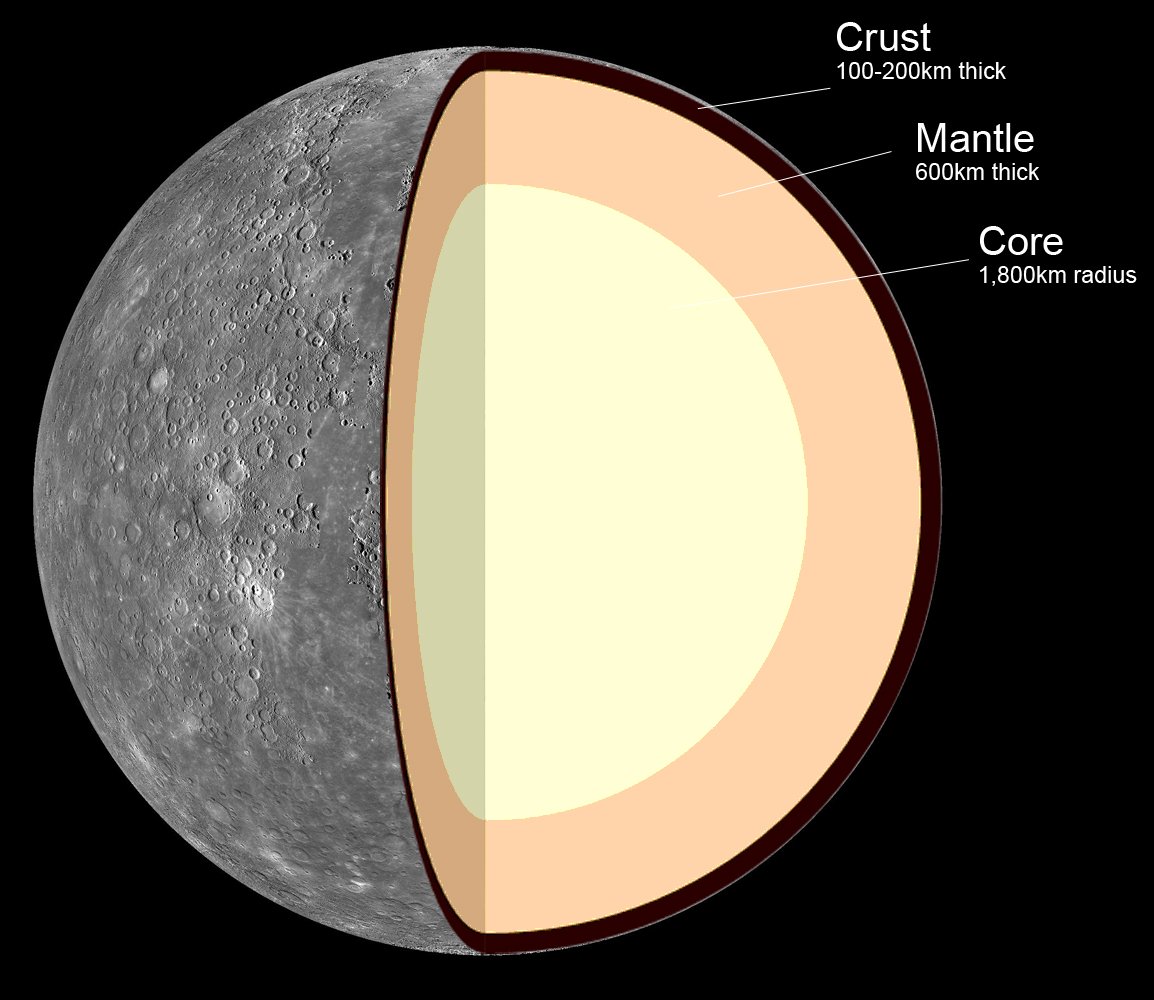
Ganymede is wider than Mercury: at 5,268 km across, it is the solar system’s largest moon. Made largely of rock and ice, it has only about half Mercury’s mass, its own magnetic field, and possibly an immense hidden ocean.
A moon larger than a planet
Galileo discovered it with the other large Jovian moons in January 1610. It orbits about 1.07 million km from Jupiter in roughly 7.2 Earth days. Size alone does not make it a planet: it orbits Jupiter.
A magnetic field of its own
Galileo’s 1996 flyby discovered an intrinsic field generated by a moving liquid iron core, analogous to Earth’s. It guides particles into a thin oxygen atmosphere to produce auroras, even while embedded within Jupiter’s stronger field.
An ocean under the ice
In 2015, Hubble observations showed auroral bands rocking less than expected. A conducting salty ocean could generate an induced field that suppresses this motion. It may be hundreds of kilometers deep and hold more water than all Earth’s oceans.
Models place an iron core inside a rocky mantle, with a buried ocean between ice layers and an outer shell potentially hundreds of kilometers thick.
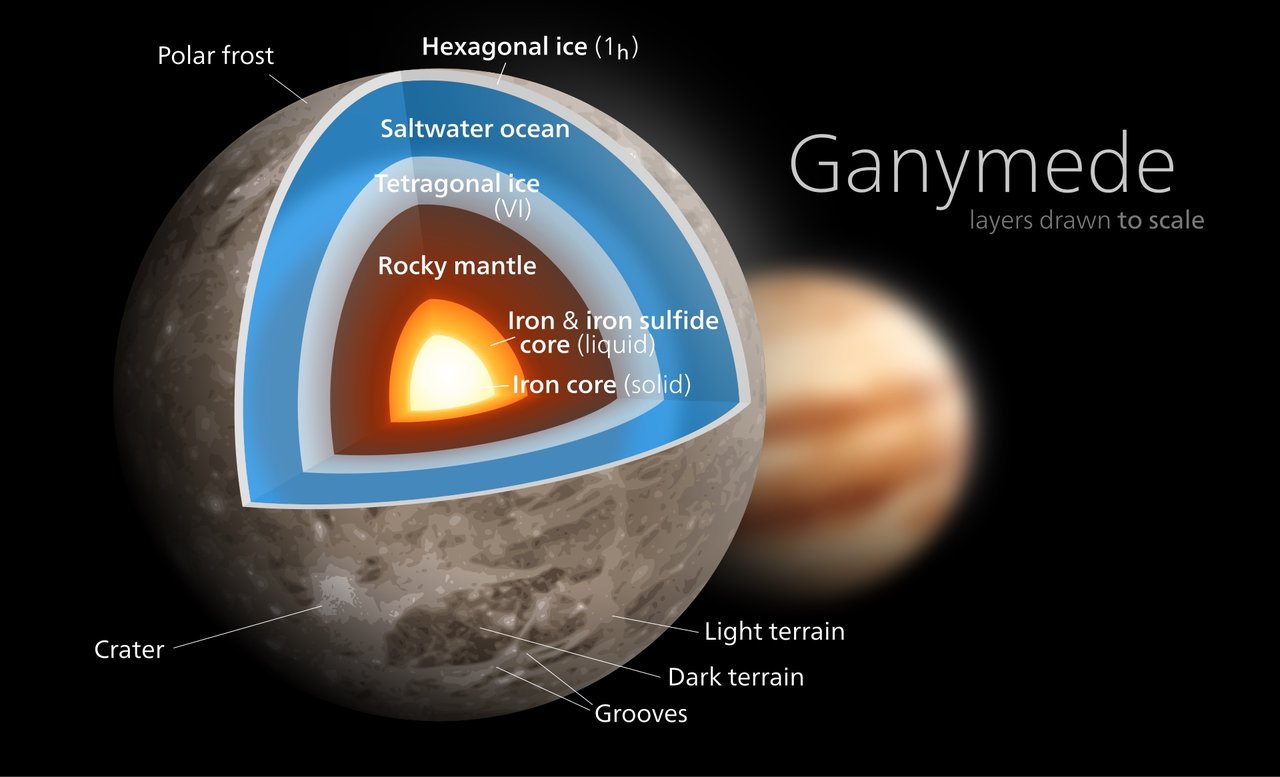
Bright and dark terrain
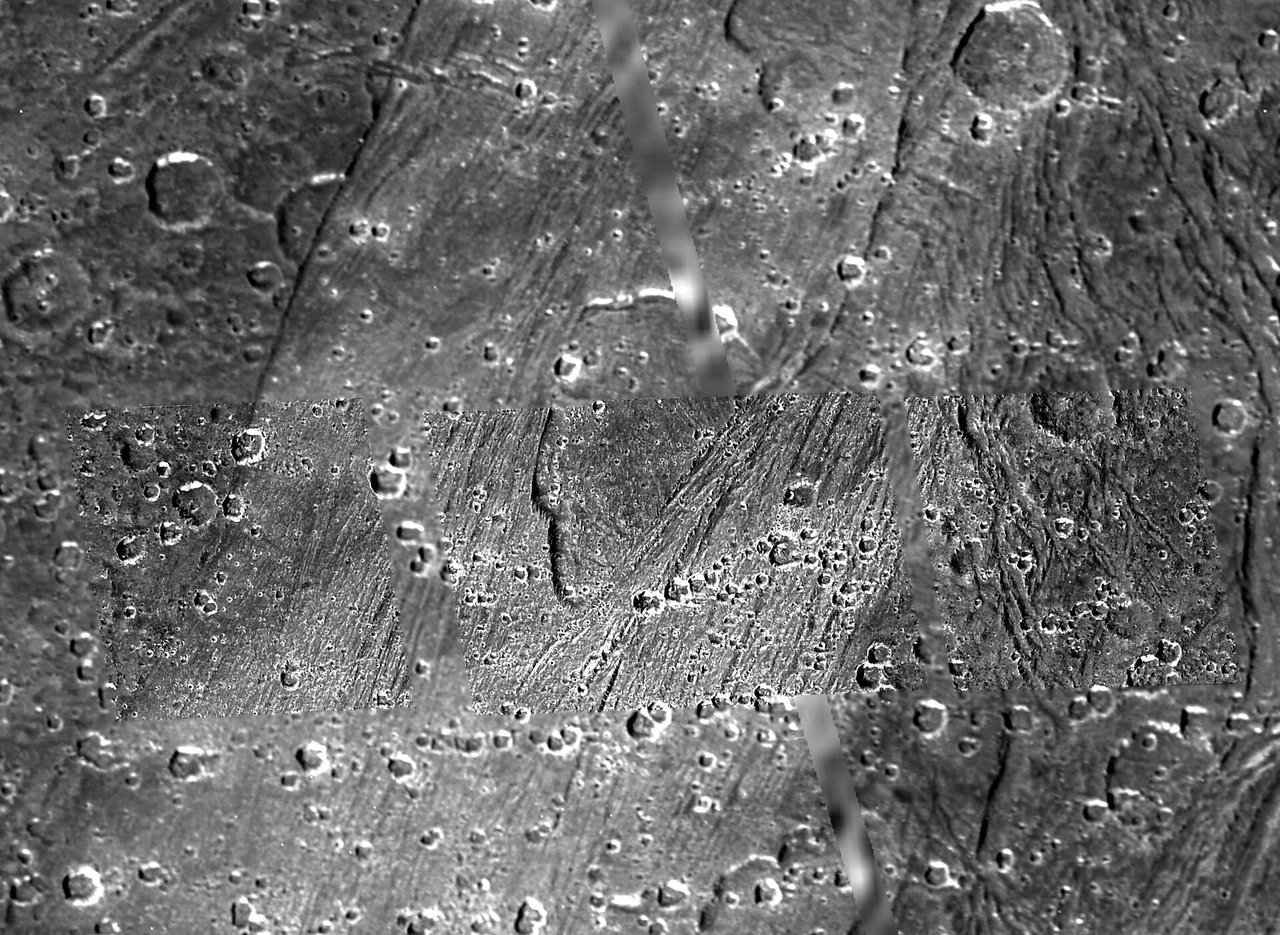
Dark, heavily cratered regions are around four billion years old. Brighter grooved areas record stretching and resurfacing, with parallel ridges and troughs. Hubble also detected an extremely thin oxygen atmosphere.
What would the view be like?
The sky would be black. Jupiter would appear many times wider than our full Moon, potentially revealing cloud bands and the Great Red Spot. Tidal locking keeps Jupiter in roughly the same place over the facing hemisphere. Extreme cold and energetic particles still demand substantial protection.
JUICE: exploring icy moons
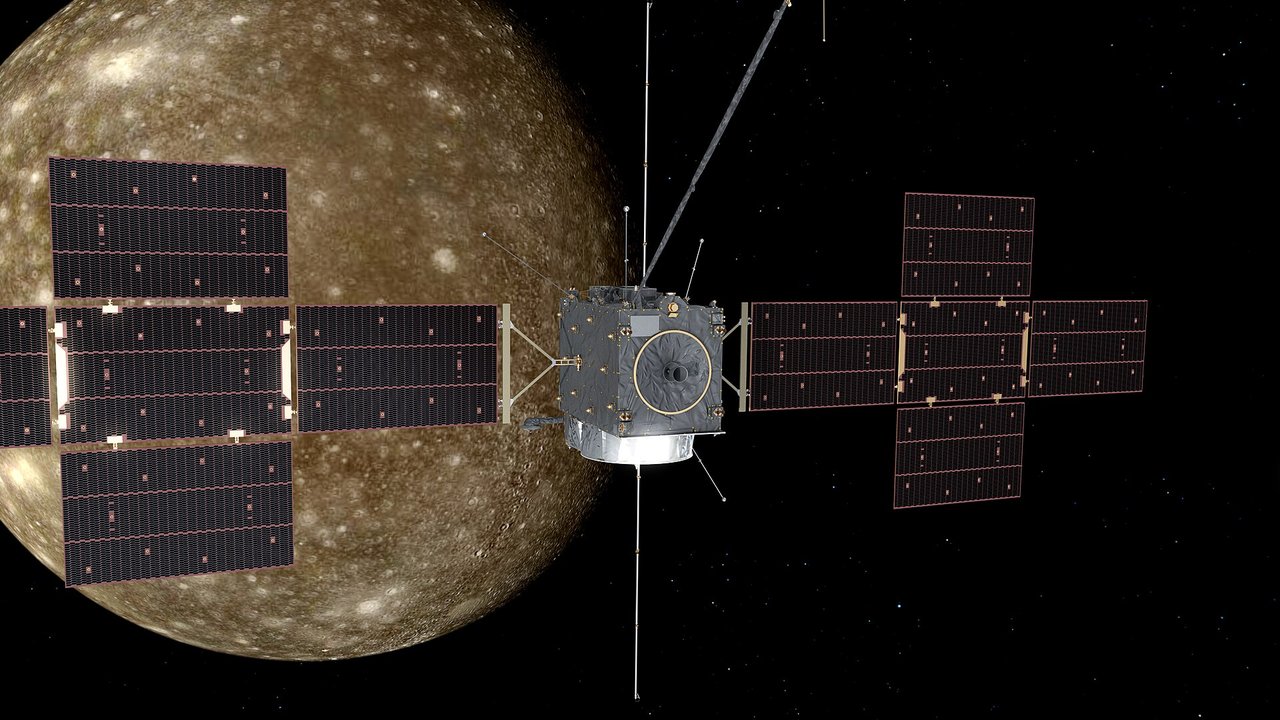
ESA’s JUICE launched on April 14, 2023 and uses gravity assists toward a planned July 2031 arrival. After flybys of Ganymede, Europa, and Callisto, it aims to enter Ganymede orbit in December 2034, becoming the first orbiter of a moon beyond the Earth–Moon system. Radar, gravity, and magnetic measurements will probe the ice and ocean.