Haumea: spinning a sphere into an ellipsoid
This unusual Kuiper Belt dwarf planet spins once in about 3.9 hours, stretching into a three-axis ellipsoid. It has a narrow ring, two moons named after daughters of a Hawaiian goddess, and a surface dominated by crystalline water ice.
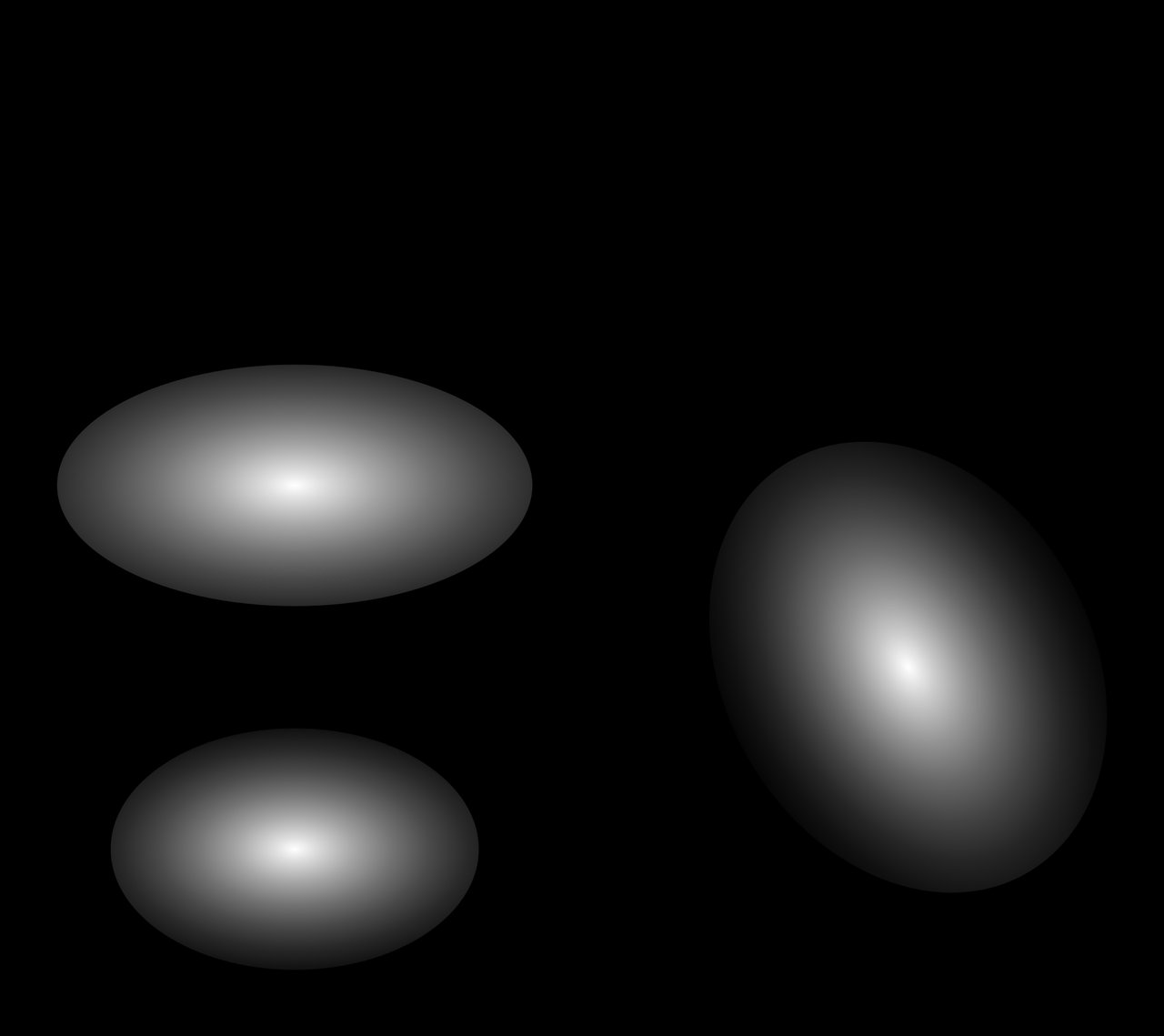
Haumea spins like rapidly turned dough, stretching into an elongated shape in less than four hours. This Kuiper Belt dwarf planet takes about 284 years to orbit the Sun and has a narrow ring and two moons.
Rapid rotation
Brightness variations reveal a rotation period of about 3.9 hours, extraordinarily fast for a body this large. Its longest dimension is around 2,300 km, roughly twice the shortest. Day and night can each last only about two hours.
Shape and interior
A 2017 stellar occultation measured approximate axes of 2,322 × 1,704 × 1,138 km. Haumea is recognized as a dwarf planet, though exact size, density, and equilibrium state remain topics of study.
Why doesn’t it fly apart?
Gravity still holds the material together despite rotation pulling outward at the equator. The result is elongation rather than total breakup. A density around 1.9 g/cm³ implies a dense rocky interior beneath a thinner icy exterior, rather than a pure ice ball.
A ring and two moons
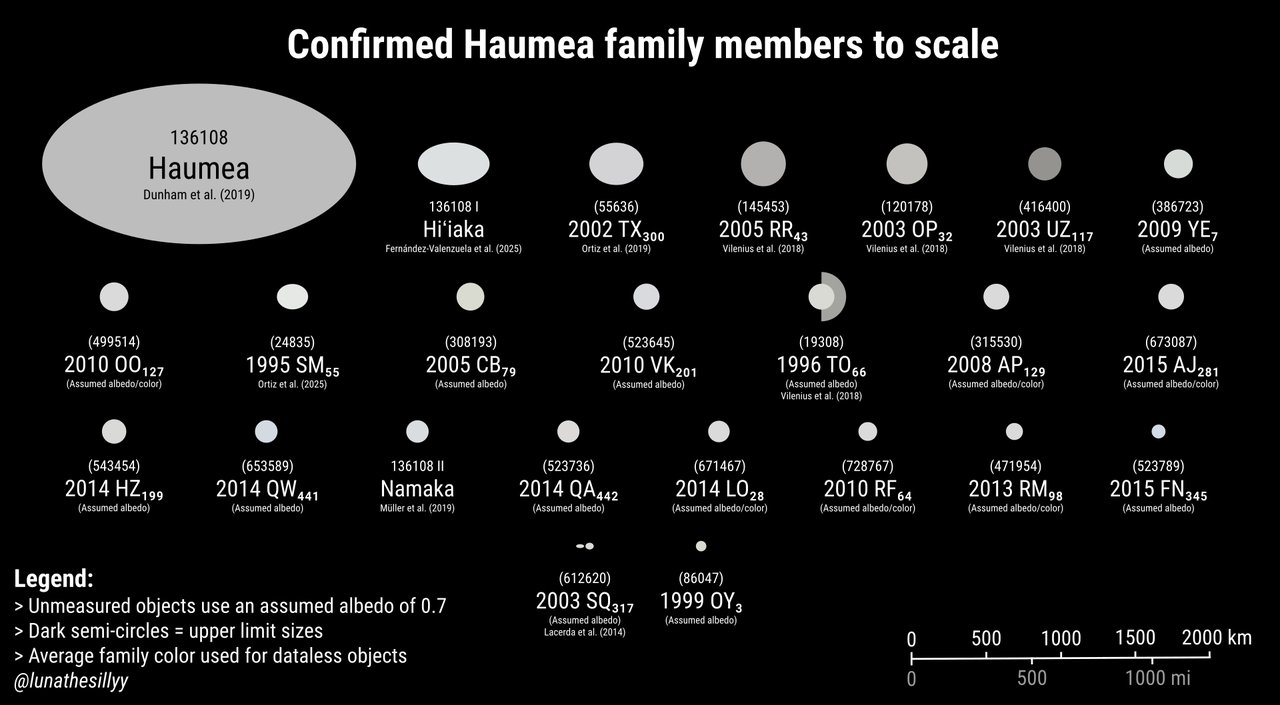
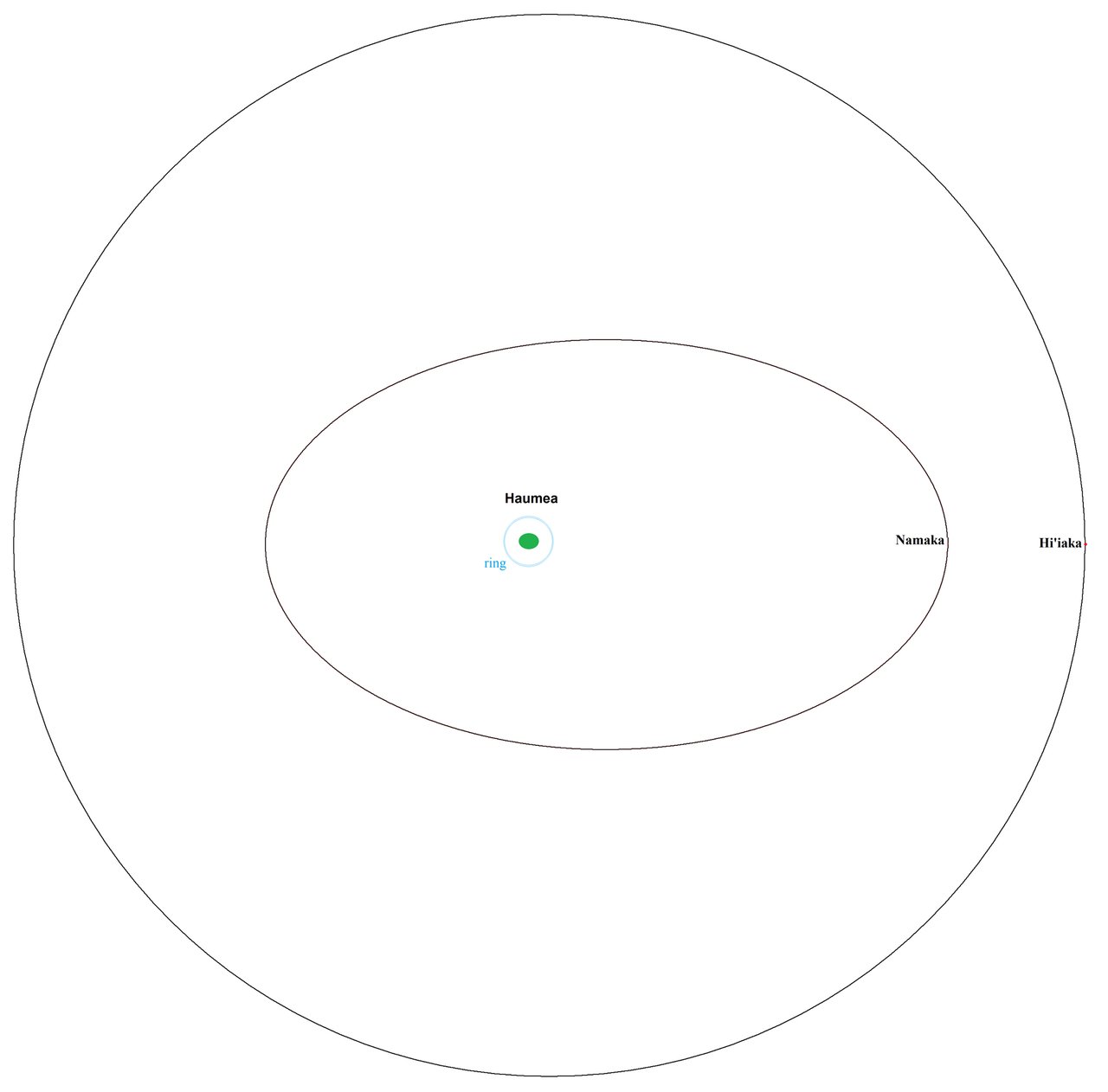
The same 2017 occultation revealed a faint ring about 70 km wide at a radius around 2,287 km—the first confirmed ring around a trans-Neptunian object. Hiʻiaka, the larger outer moon, is around 310 km across; inner Namaka is roughly 170 km.
Named for a Hawaiian goddess
Mike Brown’s team discovered the object in 2004; José Luis Ortiz’s team also reported 2003 observations, leading to a discovery dispute. It was formally named and recognized as a dwarf planet in September 2008.
Haumea is a Hawaiian goddess of fertility whose children emerged from her body, an apt association for moons and fragments thought to originate from this world. The moons bear her daughters’ names.
Bright crystalline ice
An albedo around 0.8 and spectra show abundant crystalline water ice. Radiation should gradually disorder such ice, so its persistence suggests resurfacing or another renewal mechanism not yet settled. A darker red region adds another puzzle.
A collision family
A major ancient collision may link its fast spin, elongated shape, moons, ring, and icy surface. Ejected fragments formed a family on related orbits, sharing distinctive crystalline-water-ice spectra. These similarities are evidence of common ancestry, though details of formation remain under investigation.