Hubble Space Telescope (HST)
This NASA/ESA observatory launched on April 24, 1990. Its 2.4-meter primary mirror and five shuttle servicing missions enabled images such as the Pillars of Creation and the deep fields; it remains in orbit.
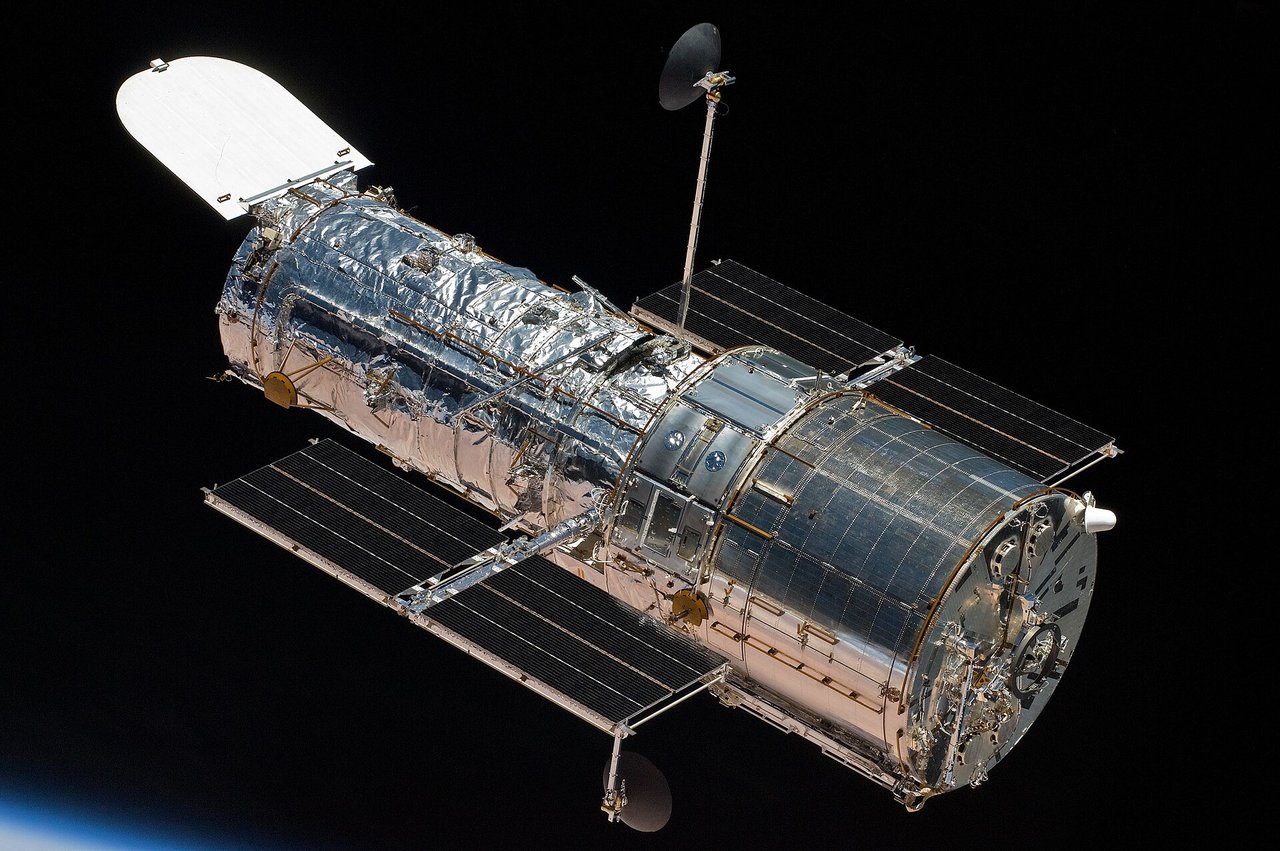
What can a school-bus-sized telescope see from space? For over thirty years, Hubble has shown us newborn stars, distant galaxies, and changing storms on Jupiter.
Built jointly by NASA and ESA and named after Edwin Hubble, it launched aboard Discovery on April 24, 1990. It now operates in low Earth orbit about 540 km high.
Why put it in space?
Atmospheric turbulence makes starlight shimmer, and the atmosphere blocks some ultraviolet and infrared radiation. Above it, Hubble obtains clearer, steadier images without clouds.
Its 2.4 m primary mirror collects ultraviolet, visible, and near-infrared light. NASA Goddard operates the telescope, while the Space Telescope Science Institute schedules observations and processes data.
What has it photographed?
Hubble studies planetary weather, stellar birth and death, galaxy distances, and matter moving around black holes. Long exposures slowly collect faint light rather than taking ordinary snapshots.
In 1995 it photographed the Pillars of Creation: cold gas and dust forming new stars in the Eagle Nebula, M16. That year it also stared at a seemingly empty patch for about ten days, producing the Hubble Deep Field and revealing thousands of distant galaxies.
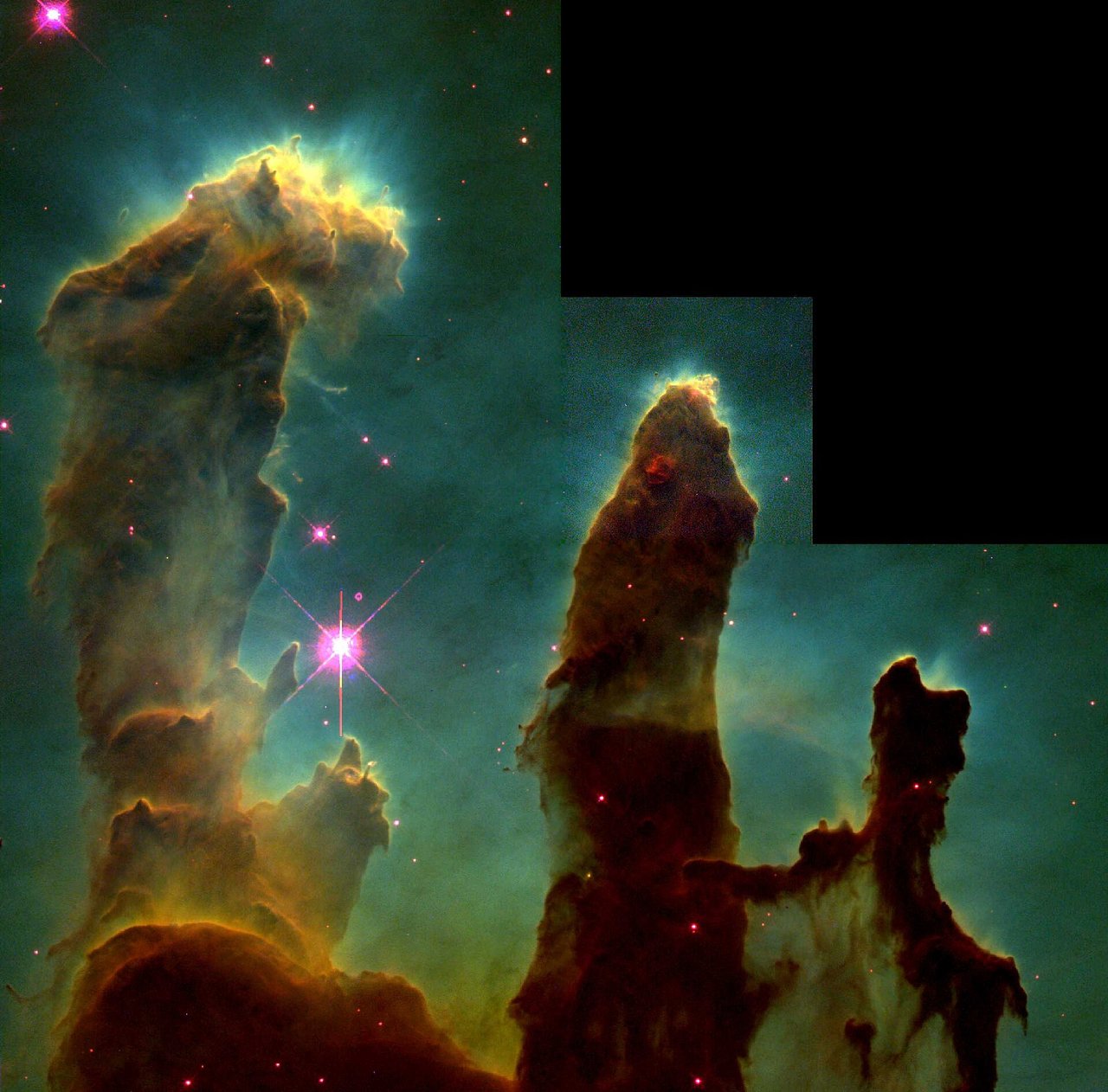
Are Hubble’s colors real?
Some resemble what eyes would see; others combine assigned colors from different wavelength bands. Like a temperature map, this reveals gases, temperatures, and structures rather than coloring arbitrarily.
Corrective optics saved the telescope
After launch, spherical aberration in the primary mirror made images blurrier than expected. In 1993, astronauts installed COSTAR corrective optics and replacement instruments with built-in correction. By 2009, five shuttle servicing missions had repeatedly renewed the observatory.